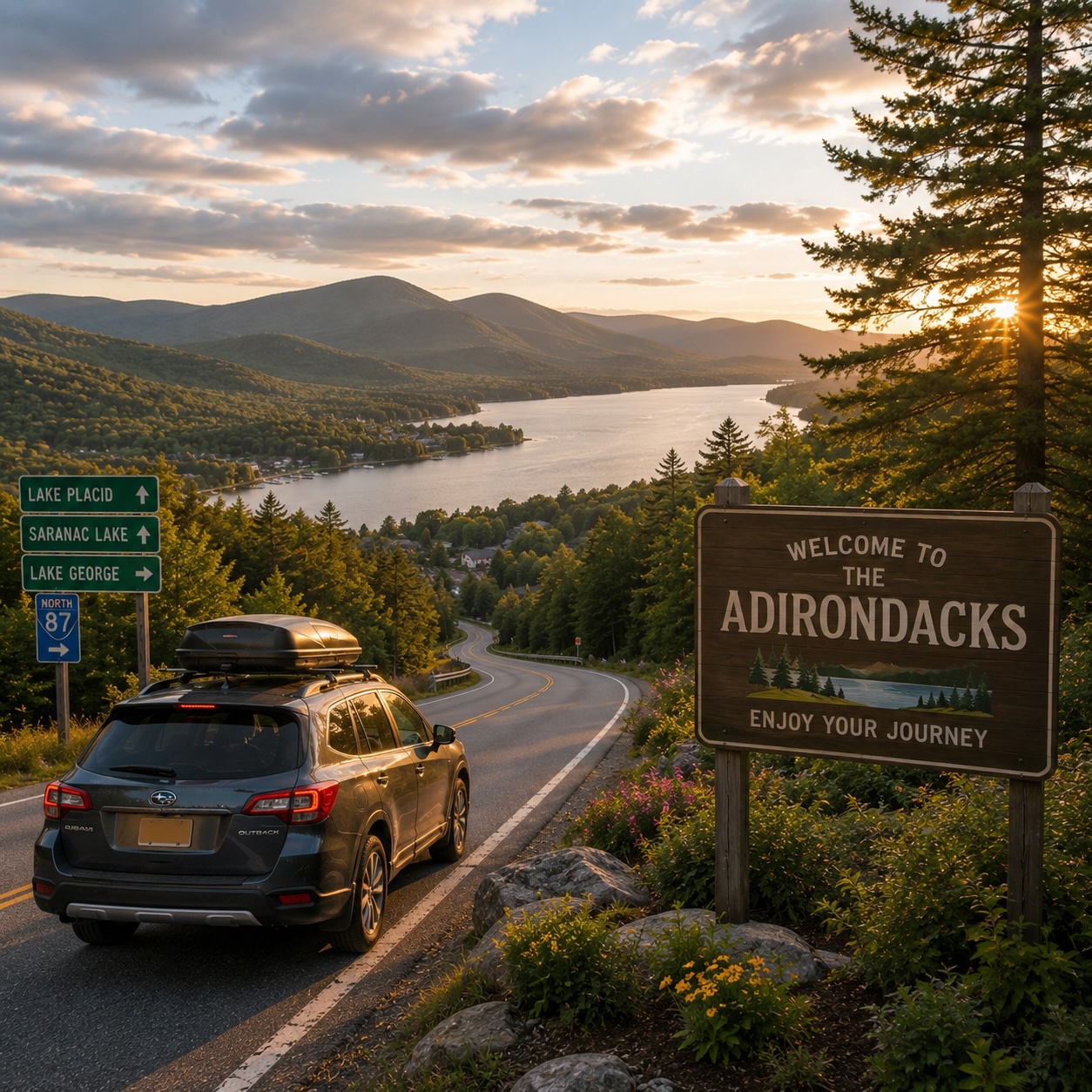
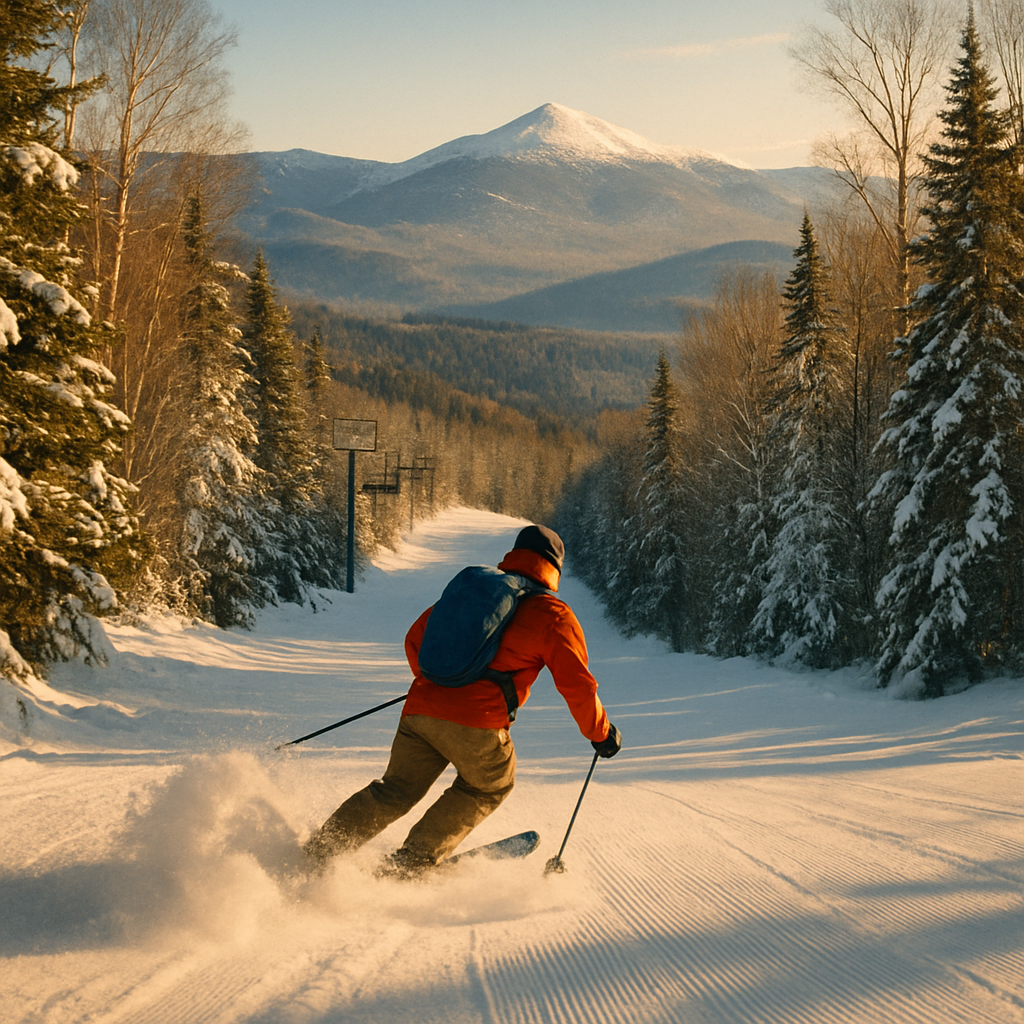
Why ski the Adirondacks.
The Alps have altitude. We have honesty — cold, natural snow and a fall line that doesn't apologize.
This is where American ski racing grew up. Two Winter Olympics (1932 and 1980) were held here; the ski train once ran skiers from New York City to North Creek; and the terrain is the real thing — 3,430 feetof lift-served vertical at Whiteface, the biggest drop east of the Rockies. But the Park is more than its two giants. It's a town hill with a $30 ticket, a volunteer-run rope tow, a floodlit tubing hill, and 55 km of Olympic-grade cross-country all within an hour of each other. This guide covers all of it — starting with what the snow is doing right now.
The snow report — live.
Live summit conditions and the week's fresh-snow outlook for the flagship mountains, pulled at each summit and refreshed hourly. Read this before you pick a mountain: the western hills (McCauley) ride lake-effect and can out-snow the High Peaks overnight, while Whiteface and Gore hold the biggest terrain.
Season totals begin accumulating in mid-November — until the first storms, this reads zero by design.
This is a forward forecast, not the plowed base depth or the count of open trails — those come from each mountain's own daily report, covered next.
The ski report — reading conditions.
A snow forecast tells you what's falling; the ski reporttells you what's actually open and skiable. Every mountain posts its own each morning, and it's the number that matters on the drive up. Here's how to read one — and where to find each mountain's.
- Base depth — inches of settled snow on the ground, usually a range (e.g. 24–48"). Natural + machine-made. More base means more terrain and fewer thin spots and rocks.
- Trails & lifts open — the count that actually decides your day. Early and late season, a mountain may list a big vertical but only run a handful of trails off one lift.
- Surface — the morning's condition: powder, packed powder, machine-groomed, hard-pack, or (the honest one) icy/variable. Adirondack cold keeps snow firm — groomed-in-the-morning is your friend.
- New snow (24/48 hr) — overnight accumulation. Pair it with the live outlook above to time a powder day.
- Snowmaking — which trails were blown overnight. On a lean-snow winter this, not the sky, is what opens terrain — and Whiteface, Gore and Van Hoevenberg all make snow aggressively.
Each mountain's live daily report: Whiteface, Gore, Oak Mountain, McCauley, and Mt. Van Hoevenberg (Nordic). Bookmark the one you're headed to.
The downhill mountains.
The Park's lift-served alpine areas, biggest to smallest. Three of them — Whiteface, Gore, and Oak Mountain — carry our interactive 3D trail map: drag to orbit the mountain, and tap a run or lift to trace it down the real terrain. The essentials below each are the ones you need before you buy a ticket.
Loading USGS terrain…
Drag to orbit · scroll to zoom · click a run to inspect · terrain USGS 3DEP · imagery USDA NAIP · runs & lifts © OpenStreetMap contributors
Loading USGS terrain…
Drag to orbit · scroll to zoom · click a run to inspect · terrain USGS 3DEP · imagery USDA NAIP · runs & lifts © OpenStreetMap contributors
Loading USGS terrain…
Drag to orbit · scroll to zoom · click a run to inspect · terrain USGS 3DEP · imagery USDA NAIP · runs & lifts © OpenStreetMap contributors
Vertical, trail, and lift figures are the mountains' published stats and hold year to year; ticket prices, hours, and open terrain change constantly — always confirm on the operator's site (linked above) the week you go.
Cross-country & Nordic.
The Adirondacks may be even better known for skinny skis than fat ones. The same Olympic infrastructure that built the alpine scene left world-class groomed Nordic trails, and the backcountry touring is endless.
- Mt. Van Hoevenberg (Lake Placid) — the Olympic cross-country and biathlon venue, run by ORDA — 55+ km of groomed, snowmaking-backed trails (so it opens early and holds snow), rentals, lessons, and a modern base lodge. The gold standard for groomed Nordic in the Park, right next to the bobsled track at Van Hoevenberg.
- The Jackrabbit Trail — a ~24-mile backcountry ski route linking Keene, Lake Placid, and Saranac Lake, maintained free by the Barkeater Trails Alliance. Point-to-point classic touring through the woods — the connective tissue of Tri-Lakes Nordic.
- Lapland Lake Nordic Vacation Center (Northville) — a Finnish-themed destination in the southern Park with ~38 km of immaculately groomed trails, on-site rentals, lessons, tupa cabins, and even reindeer — see Lapland Lake.
- Garnet Hill Lodge (North River) — a lodge-based Nordic network of ~55 km near Gore, with trailside lodging and a restaurant — ski-in, ski-out cross-country.
- Dewey Mountain (Saranac Lake) & the Paul Smith's VIC — two community-minded options: Dewey's in-town trails with night skiing, and the Visitor Interpretive Center's free-to-donation groomed loops and snowshoe trails at Paul Smiths.
Nordic conditions swing fast with the weather — groomed centers like Van Hoevenberg and Lapland Lake make and hold snow, but the free backcountry trails (Jackrabbit) ski only when nature cooperates. Call the center or check its report before loading the car.
The community hills.
Beyond the headliners, the Park keeps a set of small, affordable, community-run hills alive — the places locals learned on. They run on tight budgets and snow years, so hours are limited and worth confirming, but the value (and the character) is unbeatable.
- Mount Pisgah (Saranac Lake) — the village community hill: a T-bar, night skiing, tubing, and lessons that have taught generations of Tri-Lakes kids to ski. Cheap and cheerful.
- Big Tupper (Tupper Lake) — a beloved community-run area in Tupper Lake that operates on volunteer power and snow years — call ahead or check before you drive out; when it's spinning, it's a throwback in the best way.
- Hickory Ski Center (Warrensburg) — an old-school, weekends-only mountain with surface lifts, no snowmaking, and 1,200 ft of natural-snow vertical — a purist's hill on the southeastern edge of the Park.
- Titus Mountain (Malone) — just beyond the northern Blue Line, a big family-owned value mountain with 50+ trails and night skiing — the closest full-service ski area for the Park's far-north corner.
The community hills run part-time schedules and, in the case of the volunteer-run areas, snow-dependent seasons. A long drive to a closed rope tow is a bad day — check the hill's website or call before you commit, especially early and late season or after a thaw.
The ski atlas.
Every alpine and Nordic area we track, plotted across the Park. Tap a pin for the area's page, hours, and directions.
- Whiteface MountainListing
- McCauley MountainListing
- Gore MountainListing
- Oak MountainListing
- Cloudsplitter GondolaListing
- Mt. Van HoevenbergListing
Tickets, rentals & getting there.
A few things that save money and headaches, whichever mountain you pick.
| When | What |
|---|---|
| Buy online, early | Whiteface and Gore price tickets dynamically — the same day costs more at the window than booked days ahead online. If you ski a few days, the Ski3 pass (Whiteface + Gore + Belleayre) pays off fast. |
| Reserve rentals | All the majors rent on site, but weekend and holiday shops back up. Reserve your gear online with your ticket, or rent in town the night before to skip the morning line. |
| Book a lesson right | First-timer packages that bundle a lesson, rental, and beginner-lift ticket are the cheapest way to start — and the small hills (Oak, McCauley, Pisgah) are gentler places to learn than a 3,400-foot Olympic mountain. |
| Plan the drive | Mountain roads ice up and the passes get wind-blown snow. Carry a scraper and a blanket, keep the tank above half, and give yourself extra time — the Northway and Route 73 both see winter weather the valleys don't. |
| Dress for the summit | The reading that matters is the summit temperature and wind, not the base lodge. Goggles, a real face cover, and layers you can vent — Adirondack cold is the genuine article. |
Far more Adirondack ski trips go wrong on the road than on the hill. Route 73, the Northway, and the town roads to the smaller areas get black ice, blowing snow, and sudden whiteouts. Slow down, leave room, and if the forecast turns, there's no shame in skiing the closer hill.
Frequently asked questions.
It depends what you want. For the biggest, most challenging terrain, Whiteface Mountain in Wilmington has the greatest lift-served vertical drop in the East (3,430 feet) and Olympic pedigree. For the most trails and acreage, Gore Mountain near North Creek is New York's largest ski area. For an affordable, family-friendly day, Oak Mountain (Speculator) and McCauley Mountain (Old Forge) are hard to beat — and McCauley catches some of the best lake-effect snow in the Park.
This guide has interactive 3D trail maps for Whiteface, Gore, and Oak Mountain — you can orbit the real terrain and trace individual runs and lifts down the mountain. For the other areas, the operator's website has the official 2D trail map, and our ski atlas map plots every alpine and Nordic area across the Park.
This guide shows a live summit snow report — current temperature and a 7-day fresh-snow outlook pulled at each summit — at the top. For the operational report (base depth, trails and lifts open, surface conditions), check the mountain's own daily report: whiteface.com and goremountain.com both post one each morning. The forecast tells you what's coming; the mountain's report tells you what's actually open.
The core season runs December through March, with the biggest mountains (Whiteface, Gore) often opening in November and running into April in strong snow years thanks to aggressive snowmaking. January and February are the most reliable months for cold, deep snow. The community hills and backcountry Nordic trails are the most weather-dependent and run shorter seasons.
Yes — some of the best in the country. Mt. Van Hoevenberg near Lake Placid is the former Olympic venue with 55+ km of groomed, snowmaking-backed trails, rentals, and lessons. Lapland Lake near Northville is a beloved groomed destination, Garnet Hill near Gore offers ski-in/ski-out lodging, and the free 24-mile Jackrabbit Trail links Keene, Lake Placid, and Saranac Lake for backcountry touring.
Whiteface and Gore use dynamic online pricing, so a single day is cheapest when booked in advance rather than at the window, and the multi-mountain Ski3 pass (Whiteface, Gore, Belleayre) saves money over a few days. The smaller and community hills — Oak Mountain, McCauley, Mount Pisgah — are dramatically cheaper, among the best-value lift tickets in the Northeast. Because prices change every season, always confirm the current rate on the operator's site before you go.
The smaller hills. Oak Mountain (Speculator), McCauley (Old Forge), and Mount Pisgah (Saranac Lake) all have gentle terrain, short lift lines, and first-timer lesson-and-rental packages, making them far friendlier places to learn than a big Olympic mountain. Whiteface and Gore both have dedicated learning areas and ski schools too, but the smaller hills are calmer and cheaper for your first turns.
Sources & further reading.
This guide is editorial — written to help you plan well — and is not a substitute for current operator reports. The live snow report is a weather forecast; always confirm open terrain, ticket prices, hours, and road conditions with the operator in the day or two before your trip.