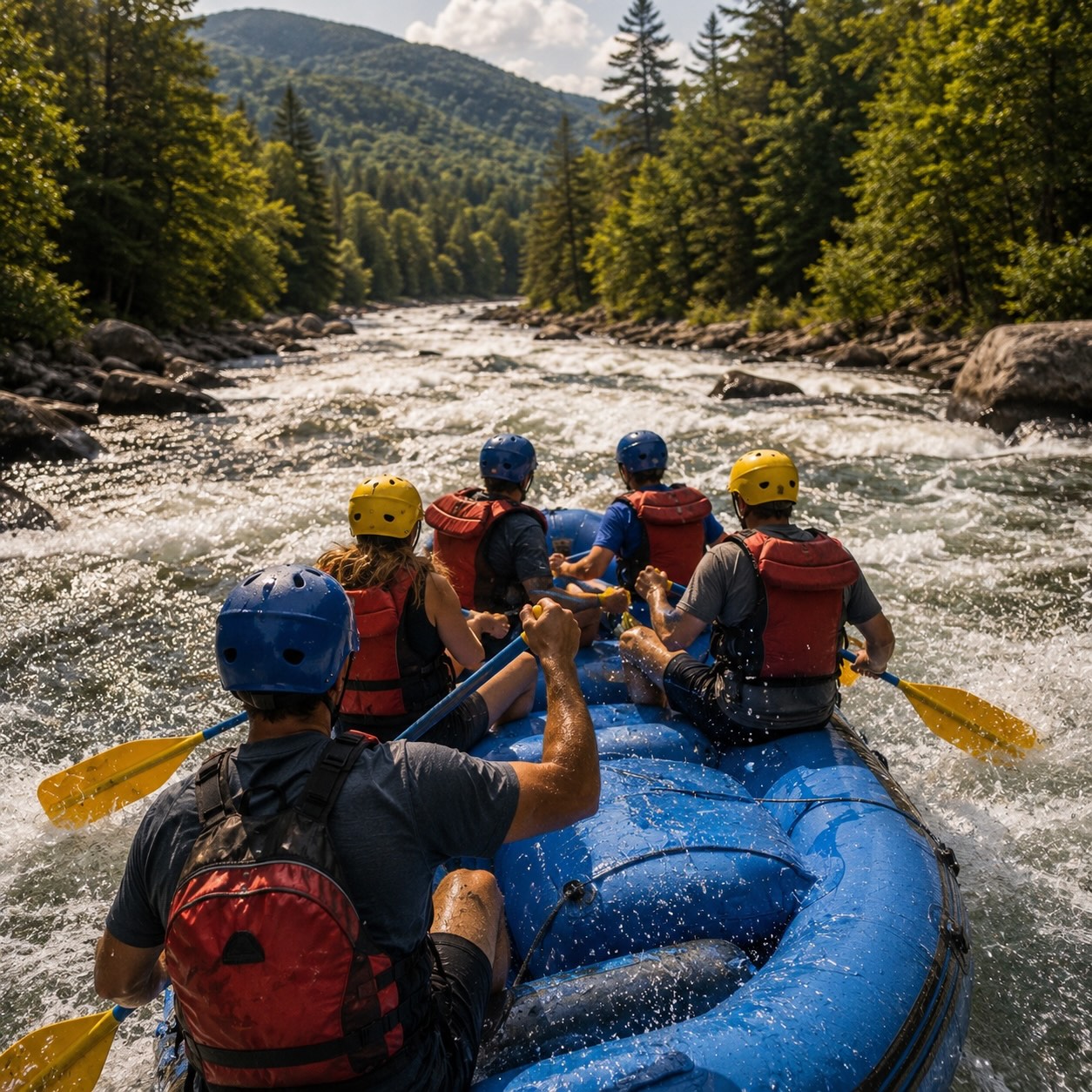
Why the Adirondacks for whitewater.
The Adirondack Park is the only place in the eastern United States where you can sign up for a commercial Class IV whitewater trip in the morning, eat lunch in a village with three coffee shops in the afternoon, and sleep in a lakeside cabin that night.
Whitewater rafting in the Park is not a side activity. It is one of the region’s flagship summer experiences, run by professional outfitters on three distinct rivers, with a fifty-year operational history and a dam-release schedule that has, almost uniquely in the East, decoupled the sport from the weather. When the natural rivers of New England are running too low to raft by late June, the Hudson is still going — because the water comes out of a dam on a published schedule.
The story has three rivers. The Hudson Gorge is the marquee — seventeen miles of Class III-IV through a wilderness corridor, run commercially every day there is a Lake Abanakee release. The Moose River out of Old Forge runs Class IV-V on spring snowmelt and is genuinely serious whitewater for experienced rafters and expert kayakers only. The Sacandaga River out of Lake Luzerne is a short, scheduled, family-friendly Class II-III run that makes a real whitewater day available to anyone over the age of six.
Indian Lake, Hamilton County, and the Town of Lake Luzerne have built tourism economies around this resource over the last half-century. Outfitters here run more raft trips in a summer than anywhere else in the state. The Whitewater Derby — a sixty-year-old race weekend on the Hudson at the first weekend of May — is the oldest continuously-running whitewater race in North America.
Whitewater rafting is a real outdoor risk, even with a guide in the boat. Cold-water immersion, undercut rocks, foot entrapment, and swimming in fast current are all things that go wrong on a perfectly normal day. The outfitters listed here are professional operations with strong safety records — but no professional operation can eliminate the risk, only manage it. If the safety briefing sounds serious, that is because it is.
The three rivers, side by side.
Before the river-by-river deep dives, the comparison table that answers the only question most first-timers actually ask: which one’s right for me?
| River | Put-in | Class | Length | Season | Source | Min age | Best for |
|---|---|---|---|---|---|---|---|
| Hudson Gorge | Indian Lake area | III-IV | ~17 mi | Apr through mid-Oct | Dam-fed (Lake Abanakee release) | Typically 14+ (12+ on lower-water days) | The full Adirondack rafting day. Wilderness corridor, big rapids, the marquee experience. |
| Moose River (bottom) | Old Forge / McKeever | IV-V | ~5 mi | April only (snowmelt) | Natural flow | Typically 16+ or 18+ | Expert paddlers and adventurous rafters with prior whitewater experience. Not a first-time trip. |
| Sacandaga (lower) | Lake Luzerne | II-III | ~3.5 mi | Late May through Labor Day | Dam-fed (Stewart's Bridge release) | Typically 6+ or 8+ | Families, first-timers, half-day trips. The right introduction to whitewater. |
Minimum ages vary by outfitter and by water level — always confirm. Outfitters also set their own weight, swimming ability, and medical-condition limits on the bigger runs.
The dam-release magic — why the Hudson runs in July.
Here is the single fact that explains why Indian Lake is the rafting capital of New York and not, say, the Catskills or western Massachusetts.
In most of the East, whitewater rivers run on natural flow — snowmelt in spring, big storms in summer, leaves down by October. They’re glorious in April and dry by July. The Hudson does not work this way. The water you raft on the Hudson Gorge comes out of Lake Abanakee, a small impoundment north of Indian Lake, on a scheduled release coordinated by the Town of Indian Lake. The dam opens on a published timetable, the water travels down the Indian River, joins the Hudson upstream of the Gorge, and — six hours and seventeen miles later — the rafts take out at North River with the water dropping behind them.
In practice this means the rafting season is decoupled from the weather. Daily releases run through spring. Through high summer, releases drop to roughly four or five days a week, often weighted toward Friday-Saturday-Sunday. Through early fall, the schedule shifts again. The result is a river you can plan a trip on in July, in August, in October, in a way that is almost impossible anywhere else in the Northeast.
The Sacandaga benefits from a similar arrangement — its scheduled releases come from Stewart’s Bridge Dam on the Sacandaga River, operated by Brookfield Renewable. Those releases are timed to the afternoon-rafting window roughly Memorial Day through Labor Day and create the dependable, family-friendly Class II-III run on the lower Sacandaga out of Lake Luzerne.
The Moose, by contrast, runs on natural snowmelt. There is no dam to keep it going. When the snow is gone and the ground is dry, the Moose closes for the year — sometimes by the first week of May.
The Town of Indian Lake publishes the Hudson release schedule annually, but specific dates and times can shift on short notice — drought management, dam maintenance, and unusual hydrology all factor in. Always confirm your specific trip date directly with the outfitter, who is tracking the release schedule daily.
The Hudson Gorge — the marquee run.
Indian Lake Hamlet is the operational center of the Hudson Gorge trade. From the town beach on the lake itself, you would not guess it — it looks like a small Adirondack hamlet of about a thousand people. But on a release morning in June, the parking lots fill with outfitter vans, rafters in their issued wetsuits and helmets, and a low hum of pre-trip safety briefings under the trees.
Most commercial trips put in on the Indian River just below the Lake Abanakee dam. The first three miles are flat to quickwater — the warm-up — and the guides use this stretch for paddle commands, swimming drills, and the practical lessons that, an hour later, will matter. The Indian then joins the Hudson River proper at a confluence locally known as the Joint. From there, the Hudson Gorge begins.
The Gorge itself
The Gorge is fourteen miles of continuous Class II to IV whitewater through a deep wilderness corridor with no road access. Once you’re in, you’re committed — the only way out is downstream. The walls climb to a thousand feet above the river in places. There is no cell service. There are bald eagles, occasional bears, and almost certainly nobody on the bank.
The named rapids — Cedar Ledges, Givney’s Rift, The Big Nasty, OK Slip Falls (the named rapid; the actual waterfall is just off the river), Gunsight, Harris Rift — are the structure of the trip. Each one is scouted from the boat by the trip leader, run in a specific line, and remembered for years after. Most are Class III at typical release levels; a couple push Class IV at higher water in spring.
The take-out and the shuttle
Most trips end at North River on a riverside take-out about seventeen river miles below the Indian put-in. From there, the outfitter shuttles you back to your car — usually a thirty-to-forty-minute drive, often with a stop for the post-trip meal. Plan for the full day: a typical Hudson Gorge trip runs about six to eight hours from check-in to back-in-the-parking-lot.
- Best for: Anyone in reasonable physical shape who wants the real Adirondack rafting experience and can commit to a full day on the water.
- Minimum age: Usually 14, sometimes lowered to 12 on lower-water summer days. Confirm at booking.
- Skill level: No prior whitewater experience required. The guide is in the boat. Following commands and staying calm are the only real requirements.
- Water temperature: Cold in April and May (often 45-55°F). Outfitters provide wetsuits and splash jackets for spring trips. Summer water is more forgiving but still cold by river standards.
The Moose River — Class V, three weeks a year.
The Moose River is the Park’s expert run. It is run commercially by a small number of outfitters in a very short snowmelt window — typically the last two weeks of March through the third week of April — and not at all after the spring runoff is finished. By May the river is too low. By June it is a fishing stream.
There are technically three sections that get paddled — the Upper, Middle, and Bottom Moose — and they vary in difficulty. The commercial outfitters who run the Moose run the Bottom Moose, the lowest five-mile section from the McKeever launch down to the confluence with the Black River. At peak spring flow it holds Class IV-V rapids — Mixmaster, Knife’s Edge, Crystal, Funnel, Fluming Falls — that are genuinely serious. People get hurt on the Moose. Outfitters who run it require either prior whitewater experience or a higher minimum age (16 or 18) and reserve the right to turn prospective rafters away on the morning of the trip if the water is high.
If you are an experienced commercial rafter who has done the Hudson and wants the next step, the Moose is the next step. If the Hudson would be your first trip, the Moose is not it.
Outfitters that run the Moose are explicit about this in their marketing and at check-in. Cold water, technical rapids, and a short bailout window mean that even a strong swimmer in a wetsuit who comes out of a raft on the Bottom Moose is going to have a serious experience getting back in. Listen to the outfitter when they tell you which trip to book.
The Sacandaga — the right first whitewater trip.
The lower Sacandaga River, out of the village of Lake Luzerne at the southeastern edge of the Park, is a short scheduled-release Class II-III run that is, almost certainly, the right first whitewater trip for most visiting families.
The water comes out of Stewart’s Bridge Dam on the Sacandaga, downstream of the much larger Great Sacandaga Lake. Brookfield Renewable runs the dam and times the release for a roughly two-hour rafting window in the afternoon most summer days — the exact schedule shifts year to year but the season runs Memorial Day weekend through Labor Day weekend, often a bit longer at each end.
The run itself is short — about three and a half miles — and takes roughly an hour and a half on the water. The named rapids — The Lake Luzerne Drops, The Plunge, Big Eddy — are real Class II-III features with enough bounce to thrill a nine-year-old but well within the comfort zone of any reasonably fit adult. There is at least one outfitter offering inflatable-kayak (ducky) trips on this stretch alongside the standard rafts.
- Best for: Families with kids 6 to 12, first-time rafters, anyone wanting an afternoon on the water without committing to a full day.
- Minimum age: Usually 6 or 8 (varies by outfitter). Some outfitters offer a younger-children float trip on adjacent flat sections.
- Length of trip: About two to three hours total from check-in to back at the cars; roughly ninety minutes on the water.
- Reasonable pairing: Half-day rafting in the afternoon, beach time at one of the Lake Luzerne or Lake George swimming beaches in the morning, dinner in Lake George village or Warrensburg.
Reading the international class system.
Outfitter marketing throws around “Class III” and “Class V” freely, but the underlying system is genuinely useful and worth a paragraph of explanation. The International Scale of River Difficulty goes from I to VI.
- Class I. Moving water with small ripples. Almost nothing to do. Children can paddle it.
- Class II. Easy rapids, clear channels, occasional maneuvering. Beginners with a guide handle it fine.
- Class III. Moderate rapids, irregular waves, narrow passages requiring complex maneuvers. Most of the Hudson Gorge is here. Wet, fun, well within the reach of a healthy adult with a good guide.
- Class IV. Long, powerful rapids, predictable but turbulent. Risk of injury for swimmers. The biggest features in the Hudson Gorge and most of the Bottom Moose live here.
- Class V. Extreme, long, violent rapids with significant hazards. Rescue is difficult. Commercial rafting at Class V is uncommon and only run on a few rivers in North America — the Bottom Moose at peak spring flow is one of them.
- Class VI. Effectively unrunnable. Generally only attempted by elite expedition kayakers under exceptional conditions. None of the commercial Adirondack runs include Class VI.
A single river usually contains a range. The Hudson Gorge, for example, is mostly Class II-III with named Class IV rapids at the bigger features. Outfitter marketing typically describes the river by its peak difficulty — so “Class IV rafting on the Hudson” means the river includes Class IV rapids, not that you spend six hours in continuous Class IV water.
Season & release calendar.
The shape of the Adirondack rafting season, river by river:
| Month | Hudson Gorge | Moose (Bottom) | Sacandaga |
|---|---|---|---|
| March | Closed (cold + ice) | Snowmelt builds — outfitters preparing | Closed |
| April | Opens; daily releases; peak spring water | Peak season — Class IV-V — experts only | Closed |
| May | Daily releases; Whitewater Derby first weekend | Closing as snowmelt finishes | Opens Memorial Day weekend |
| June | Releases ~5-6 days a week | Closed | Daily releases through summer |
| July | Releases ~4-5 days a week, weekend-weighted | Closed | Peak family season |
| August | Releases continue, similar weekend bias | Closed | Daily releases continue |
| September | Releases scale back; foliage trips start | Closed | Closes around Labor Day |
| October | Foliage trips through mid-month, then closes | Closed | Closed |
Indicative only. The Town of Indian Lake publishes the actual Hudson release schedule each spring; Brookfield Renewable publishes Stewart’s Bridge releases for the Sacandaga. Always confirm dates with your outfitter at booking.
The interactive atlas — rivers, rapids, outfitters.
The three rafting rivers anchor three distinct corners of the Park: Indian Lake and North Creek in the central Adirondacks for the Hudson Gorge, the McKeever launch in the west for the Moose, and Lake Luzerne in the southeast for the Sacandaga. The atlas below stacks all three runs on the same canvas — colored polylines for the river runs, diamond markers for the named rapids (color-coded by class from II to V), squares for put-ins and take-outs, and circles for the outfitters. Toggle a river off in the sidebar to focus the view.
The marquee Adirondack rafting day. Wilderness corridor, named Class IV rapids, full-day commitment.
- Cedar LedgesIII
- Givney's RiftIII+
- OK Slip Falls rapidIII
- GunsightIII+
- The Big NastyIV
- Harris RiftIII
Expert paddlers and adventurous rafters only. Three-week season on snowmelt.
- MixmasterIV
- Knife's EdgeIV
- CrystalIV-V
- FunnelIV-V
- Fluming FallsV
Families, first-timers, and half-day trips. The right introduction to whitewater.
- The Lake Luzerne DropsII-III
- The PlungeIII
- Big EddyII
- Hudson River Rafting CompanyNorth Creek · Hudson Gorge · Bottom Moose River · Lower Sacandaga
- Adirondack Rafting CompanyIndian Lake · Hudson Gorge
- ARO — Adirondack River OutfittersIndian Lake · Hudson Gorge
- Square Eddy ExpeditionsNorth River · Hudson Gorge · Bottom Moose River
- Wild Waters Outdoor CenterLake Luzerne · Lower Sacandaga · Hudson Gorge
- Sacandaga Outdoor CenterLake Luzerne · Lower Sacandaga
The polylines are editorial centerlines for orientation — not GPS-grade traces. Rapid placement reflects approximate river-mile positions described in outfitter logs and the American Whitewater run notes. Use the atlas to understand the shape of each run; use your outfitter for the survey-grade picture on the day.
Outfitter directory pins (live data).
For comparison, the same outfitters as they appear in our live directory — driven by the listings database and the shared place graph, so this map updates automatically as new outfitters publish and as the listings team backfills coordinates.
- Lake George Kayak Co.Listing
- Beaver Brook OutfittersListing
- Mirror Lake BoathouseListing
- St. Regis Canoe OutfittersListing
- Kayak Lake GeorgeListing
- Cloud-Splitter OutfittersListing
- Indian LakeLake
- Lake AbanakeeLake
- Lake LuzerneLake
- Fourth LakeLake
- Raquette LakeLake
- + 1 pending coordinates
Outfitters & guide services.
The Hudson and Sacandaga are run by a half-dozen long-established outfitters, most of them family operations that have been on the river for decades. Most of them run both rivers; a couple run the Moose as well. All of them are New York State licensed guide services with insurance, safety equipment, and trained staff. Pick by location, by the river you want to run, and by the trip format that fits your day.
Long-established Hudson Gorge specialist out of Indian Lake. Full-day Gorge trips and shoulder-season foliage trips.
One of the oldest commercial rafting operations in the East. Runs all three rivers, including Bottom Moose trips in early spring.
Hudson Gorge full-day trips with on-river photography and the post-trip meal. Convenient for visitors coming from the west.
Smaller-operation Hudson Gorge trips. Often a more intimate group size; also runs the Moose in spring.
The closest outfitter to the Sacandaga put-in. Daily summer Sacandaga trips, plus Hudson Gorge full-days. Family-anchor operation.
Family-focused Sacandaga rafting and ducky trips through the summer release window.
Browse the full directory of regional outfitters under Pursuits or by region under Indian Lake, Old Forge, and Lake George. The Whitewater Derby on the Hudson the first weekend in May and the annual rafting events on the Sacandaga are listed under Events.
What to bring (and what they bring for you).
The outfitter provides the technical gear — the raft, the paddle, the personal flotation device, the helmet, and on cold-water trips the wetsuit and splash jacket. What you bring is the rest of the day.
On your body
- Swimsuit or synthetic shorts (no cotton)
- Synthetic or wool top (no cotton — it stays cold when wet)
- Old sneakers or river sandals with heel straps (never flip-flops)
- Sunscreen, applied before the wetsuit goes on
- Hat with a strap (regular caps blow off in rapids)
- Sunglasses with a retainer strap
- Prescription eyewear secured the same way
In the dry bag (most outfitters provide one)
- Full change of dry clothes for after the trip
- Towel
- Sandals or shoes you don't mind wet for the shuttle
- Snacks for after
- Cash for tipping the guide (customary; ~15-20%)
- Water bottle (outfitter usually provides on-river hydration)
- Phone (left in the bus or in a dry bag — not in the raft)
Cotton is the wrong fabric for cold-water sports. Wet cotton stays wet, stays cold, and pulls heat out of your body fast. Synthetic baselayers and wool will warm back up as you paddle. Save the cotton t-shirt for after the trip.
Pricing and how to book.
Approximate pricing, before tip, as a planning baseline. Outfitters change their rates seasonally and most offer early-season or weekday discounts; the actual quote on their website is authoritative.
- Hudson Gorge full-day: Roughly $100-150 per person on weekdays, $120-180 on weekends. Includes wetsuit and post-trip meal at most outfitters.
- Sacandaga half-day: Roughly $50-75 per person. Two to three hours total. Family pricing common.
- Bottom Moose (when running): Roughly $200-300 per person. Smaller group sizes, more guides per raft, prior experience often required.
- Photography: Most outfitters offer a $20-30 photo package shot from a river vantage. The pictures are the only on-river photos you will have.
- Tipping: Customary for guides. 15-20% of the trip price, paid in cash at the take-out, is the standard.
How to book
Reserve through the outfitter’s own website. The Hudson Gorge fills out in summer — weekend dates in July and August often sell out a week or two ahead, especially for groups. The Sacandaga is more walk-up friendly because of the high daily volume. The Moose, when it runs, sells out within hours of trips being posted.
Indicate your group’s experience level honestly at booking. Outfitters will steer you to the right river and the right day. Sandbagging a beginner group onto the Moose is dangerous for everyone in the raft, including the guide.
Making a weekend of it.
A Hudson Gorge trip is an all-day event. By the time you check in at 8am and take out at 4pm and shuttle back and eat the post-trip meal, it’s late afternoon and you’re tired and salt-stung in the best possible way. Don’t try to drive home. Stay over.
For the Hudson Gorge
Indian Lake, North Creek, and North River all have lodging within fifteen minutes of the outfitters — cabins, motels, B&Bs, and a few small resorts along the lakes. North Creek has the most restaurant options. Indian Lake has the cleanest line-of-sight to the put-in and is the hamlet most identified with the rafting trade itself. For something more remote, the Garnet Hill Lodge at North River runs an old gravel ski-area lodge that has hosted rafters for forty years.
For the Sacandaga
Lake Luzerne village has motels and small cabins clustered around the river and the small in-town lakes; Lake George village is ten miles east with the full tourist-town accommodation range. The Sacandaga trip is a half-day, so pair it with morning beach time on Lake George, an afternoon on the Sacandaga, and dinner in Lake George village. A satisfying single-day itinerary.
For the Moose
Old Forge is the only practical lodging base for a Moose River trip. The hamlet runs hot in summer with Fulton Chain traffic; in spring (when the Moose is running) the village is quiet, the lake is cold, and you’ll have a wide choice of cabins and motels.
Lodging in the rafting villages goes earlier and faster than non-rafters expect — book the rooms when you book the trip. Browse Lodging by region for the in-village options.
Beyond the commercial trips — kayaking the runs.
Everything above is about commercial rafting — sign up, show up, get in the boat the guide is steering. A separate and rich whitewater community paddles these same rivers in kayaks and packrafts on natural and release flow.
- The Hudson Gorge by kayak. A serious paddle. Class III-IV in a self-supported kayak demands solid roll, swiftwater rescue training, and ideally local knowledge of the lines. The same release schedule applies — paddlers ride the bubble downstream on the same days commercial rafts run.
- The Moose by kayak. A regional expert-paddler destination. The Bottom Moose plays host every spring to a community of regional kayakers and the annual MooseFest gathering. This is Class IV-V kayaking and rescue infrastructure is the norm.
- The Sacandaga by kayak / ducky. A natural progression river for paddlers learning whitewater. Several outfitters rent duckies (inflatable kayaks) for the scheduled release. A good place to put a couple of seasons under your belt before the Hudson Gorge in a hardshell.
- Other Park rivers. The Boreas River, the upper Hudson above the Gorge, the lower Ausable, the Cedar River, and the Indian River outside the release corridor all hold paddleable whitewater in spring and early summer. None of these are commercially rafted. Hire a guide service the first time you run an unfamiliar Adirondack river.
For flatwater and wilderness canoe travel — the other half of the Park’s paddling resource — see Paddling & Kayaking the Adirondacks.
Frequently asked questions.
Commercial rafting in the Park has a strong fifty-year safety record, but it is a real outdoor activity with real risks — cold water, swift current, and rocks. Outfitters mitigate the risk through professional guides, mandatory safety briefings, PFDs and helmets, and trip leaders who scout each rapid. Listen to the briefing, follow paddle commands, and the trip is statistically very safe.
Yes — on the Sacandaga, where most outfitters take kids as young as six or eight. The Hudson Gorge typically requires age 14, sometimes 12 on summer low-water days. The Moose is for adults only. Confirm at booking.
Depends on what you want. April and early May for biggest water and most thrill (cold; wetsuits provided). Late May through June for warmer days, plenty of flow, and full daylight. July and August for warm air and water, fewer release days but still reliable. Late September into early October for foliage trips.
You don't need to be a strong swimmer for the Sacandaga or for the Hudson Gorge in normal conditions, but you should be comfortable in water and willing to get wet. Most outfitters ask about swimming ability at booking and on the day of the trip; honest answers help them place you in the right raft.
It happens. The PFD keeps you afloat, the helmet protects your head, and you'll be coached on what to do — feet downstream, on your back, hold the paddle, listen for the guide. Most swimmers are out of the water within thirty seconds. Cold-water immersion is the bigger concern in April and May, which is why wetsuits are standard then.
Almost universally no. Phones go in the dry bag in the bus, or on the take-out shuttle, not in the raft. Most outfitters offer a photo package shot from the bank so you have actual pictures of the trip.
No — both because the dam releases stop and because the river ices over. The season runs roughly April through mid-October.
The Hudson is closer to the New River (West Virginia) and the Penobscot (Maine) than to the Lehigh or the Youghiogheny. Wilder corridor, bigger water at peak, commercial-rafting-only access in many stretches because there are no roads. The Moose, when it runs, is in the same category as the Upper Yough or the Russell Fork — serious technical whitewater.
If you're a paddler, yes. The Hudson River Whitewater Derby on the first full weekend of May is one of the oldest continuously-running whitewater races in North America. Multiple classes — slalom, downriver, expert — and an entire town that turns out for race weekend. Indian Lake books up; reserve lodging in advance.
If you want the big experience: a Hudson Gorge full-day out of Indian Lake or North Creek, with a cabin at one of the in-village lodgings the night before and the night after. If you have kids: the Sacandaga half-day out of Lake Luzerne paired with a Lake George beach morning. Either way, build a real meal back into the schedule — the post-trip hunger is significant.
Sources & further reading.
This guide is editorial — written to help you plan well — and is not a substitute for current outfitter information, dam-release schedules, water-level conditions, or the outfitter’s own safety briefing on the day of your trip.