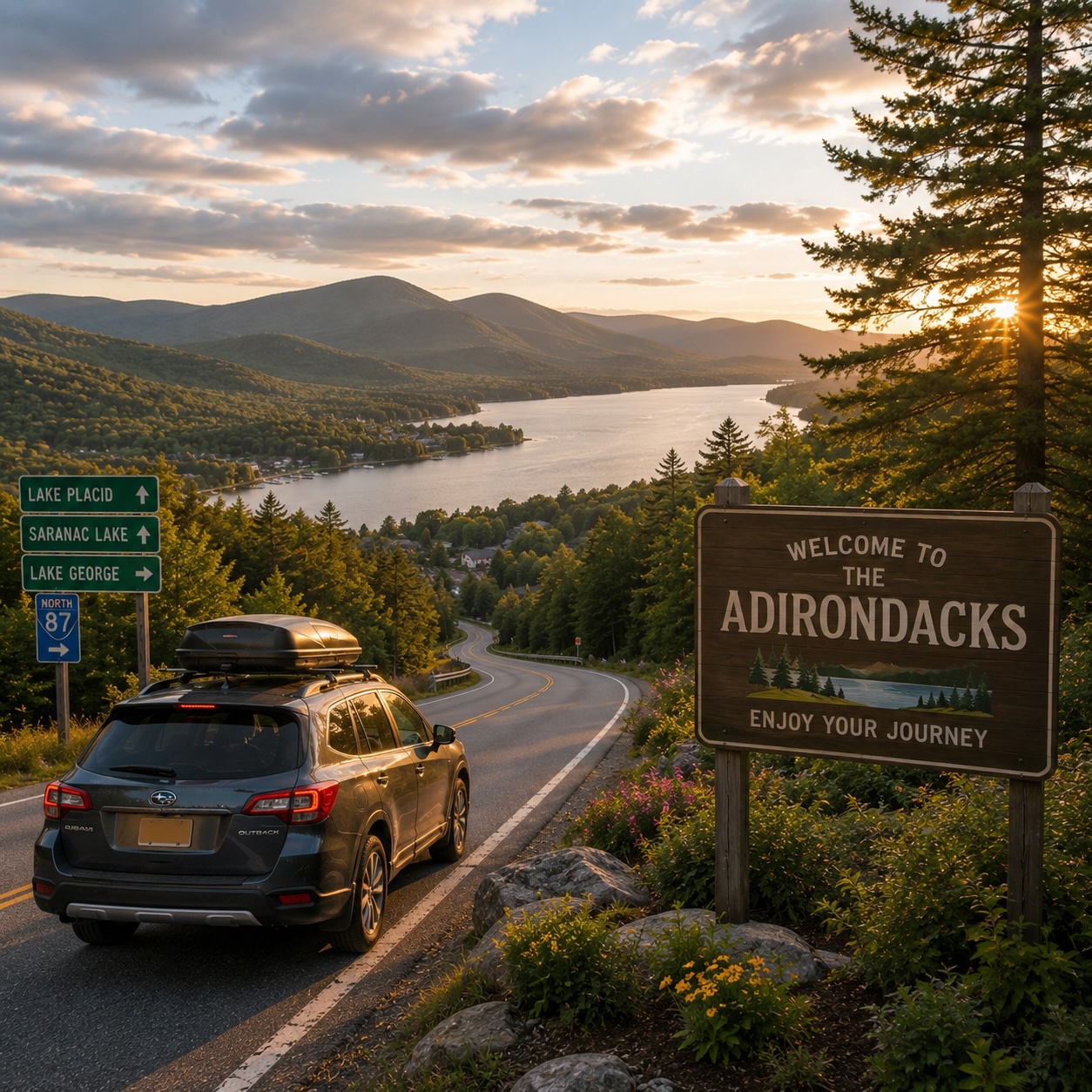
Why getting here is its own story.
The Adirondack Park is closer to you than you think — and farther into the interior than the highway map suggests.
First-time visitors consistently underestimate two things about Adirondack travel. First, how easy the front door is: Albany International Airport is ninety minutes from Lake George by car; the daily Amtrak Adirondack from New York Penn Station stops at Saratoga Springs, Glens Falls, Ticonderoga, Westport, and Plattsburgh on its way north. Second, how long the interior takes once you’re past the front door: the higher villages like Saranac Lake and Long Lake are another hour or two beyond Lake George, on two-lane state highways that climb through real mountains. The same ninety-minute drive that gets you to Lake George turns into a four-hour drive to Tupper Lake.
Every other guide on this site eventually points back here. The fishing guide assumes you can get to your put-in; the High Peaks guide assumes you can get to Heart Lake; the wedding guide assumes your guests can reach the venue from JFK. This page is the answer to all of those assumptions.
The Adirondack Park gets serious snow — Lake Placid averages 130 inches per year, the western Park (Old Forge, Inlet) over 200 inches. Routes 30, 28, 73, and the higher stretches of I-87 see real winter conditions from late November through early April. Build extra time into any winter trip, watch the forecast, and check 511ny.org for road conditions before you leave.
The interactive gateway atlas.
Every realistic way into the Park, plotted: five gateway airports, eight Amtrak stations on the Adirondack line, and ten primary highway entry points. Click any gateway for drive times to the four major ADK hubs, service details, and editorial notes on when to use it. Filter by mode in the sidebar.
- Albany International Airport· ALB
- Burlington International (Vermont)· BTV
- Plattsburgh International· PBG
- Adirondack Regional (Saranac Lake)· SLK
- Montreal–Trudeau International· YUL
- Syracuse Hancock International· SYR
- Saratoga Springs (Amtrak)· SAR
- Fort Edward / Glens Falls (Amtrak)· FED
- Whitehall (Amtrak)· WHL
- Ticonderoga (Amtrak)· TWF
- Port Henry (Amtrak)· PRH
- Westport (Amtrak)· WPT
- Port Kent (Amtrak)· PKT
- Plattsburgh (Amtrak)· PLB
- I-87 Exit 17 — Glens Falls / Lake George
- I-87 Exit 21 — Lake George Village
- I-87 Exit 24 — Bolton Landing
- I-87 Exit 28 — Schroon Lake
- I-87 Exit 30 — Cascade / Route 73 to Lake Placid
- I-87 Exit 36 — Westport / Champlain Valley
- Route 30 — Northville (south entrance)
- Route 28 — Old Forge (western entrance)
- Route 22 — Ticonderoga (eastern entrance)
Drive times are no-traffic averages between the gateway and the named destination. Holiday weekend traffic, winter storms, and routine two-lane road work can add 30-60 minutes to any of these routes — always check current conditions before departure.
By air — the five gateway airports.
Albany International (ALB) — the everyday gateway
Albany International is the default Adirondack arrival airport. Full daily service via the major US carriers (United, American, Delta, Southwest, JetBlue), direct connections to every major Northeast hub plus Chicago, Atlanta, Charlotte, Orlando, and several Florida airports. The rental car lobby is on the ground floor of the main terminal; all major brands.
From Albany, plan on about 90 minutes by car to Lake George village, 2.5 hours to Lake Placid, 2.5 hours to Old Forge, and 2.5-2.75 hours to Saranac Lake. The drive is straightforward — I-87 north from Albany, then your chosen exit. For most ADK trips, this is the simplest answer.
Burlington International (BTV) — the eastern gateway
Burlington International in Vermont is roughly the same total travel time as Albany for many High Peaks and Tri-Lakes destinations — and notably prettier. The standard approach: fly into BTV, drive 25 minutes south to Charlotte VT, take the Lake Champlain Ferry (20 minutes) across to Essex NY, and drive 45 minutes west to Lake Placid. Total: roughly 2 hours from gate to lodge, with a ferry crossing as the centerpiece.
Burlington is also a stronger option than Albany for flyers coming from the Southeast and the Mid-Atlantic who can find a direct flight; the carrier mix sometimes produces lower fares than ALB.
Plattsburgh International (PBG) — the northern shortcut
Plattsburgh sits on Lake Champlain at the Park’s northern edge, 60 minutes from Lake Placid by car. Commercial service is limited — Allegiant flies seasonal routes to Florida and select Sun Belt destinations — but for visitors who can match a flight schedule, no other commercial airport gets you closer to the High Peaks.
Adirondack Regional (SLK) — inside the Park
Adirondack Regional Airportin Saranac Lake is the only commercial airport actually inside the Blue Line. Cape Air runs seasonal service to Boston (BOS), connecting Adirondack travelers from anywhere in the world with a single layover to within twenty minutes of Lake Placid lodging. The catch: limited schedule, limited capacity, no full Saturday service in most months. When it works, it’s magic.
Syracuse (SYR) — the western alternative
For destinations in the western Adirondacks — Old Forge, Inlet, the Fulton Chain, Cranberry Lake — Syracuse Hancock International is often the right answer. Daily service, full carrier mix, often cheaper fares than Albany. The drive from Syracuse to Old Forge is about 90 minutes via Route 28.
Montreal–Trudeau (YUL) — for international arrivals
Montreal–Trudeau is the best gateway for European visitors. Direct flights from Paris, London, Amsterdam, Frankfurt, plus most major North American cities. The southbound drive crosses the US border at Champlain NY — allow 30-60 minutes for US Customs. A passport is required (Enhanced Driver’s License or NEXUS card speeds the return crossing). From the border it’s another 90 minutes to Lake Placid via I-87.
By rail — the Amtrak Adirondack line.
The Amtrak Adirondack is the only passenger train line that runs through the eastern Adirondack corridor — and it’s genuinely one of the most scenic train rides in North America. The route runs daily, year-round, between New York Penn Station and Montreal Central, with eight ADK-relevant stops along the way: Saratoga Springs, Fort Edward / Glens Falls, Whitehall, Ticonderoga, Port Henry, Westport, Port Kent, and Plattsburgh.
Why take the train
- The Hudson Valley scenery. The southbound and northbound legs of the Adirondack hug the Hudson River and then the Champlain shore for nearly the entire ride. No highway view comes close.
- Westport is the de-facto Lake Placid station. Westport is 45 minutes by car to Lake Placid — easily the most convenient rail arrival for the High Peaks region.
- Ticonderoga puts you 90 seconds from Fort Ti. The Ticonderoga station is walking distance to the fort, the village, and the lake. For an America 250 itinerary in 2026, this is the rail arrival.
- Saratoga is a destination in its own right. Many travelers stop a night in Saratoga Springs on the way in or out — the racing season, the spa, the restaurants, the gardens.
How the schedule works
The Adirondack runs once daily in each direction. Northbound departs Penn Station in the morning, reaches Westport in the afternoon, Plattsburgh in the late afternoon, Montreal in the early evening. Southbound is the inverse, departing Montreal in the morning. End-to-end the trip takes roughly ten hours; most ADK stops are six to seven hours from NYC.
Getting from the station to your destination
The Amtrak stations are train stations, not airports — most have no on-site rental car kiosk. Plan ahead:
- Westport. Pre-arrange a rental car pickup in Essex or via a Lake Placid lodge shuttle. Some Lake Placid hotels run their own arrival shuttles for guests — ask at booking.
- Plattsburgh. Has Enterprise downtown, a 10-minute taxi from the station. The largest market on the line outside Saratoga.
- Saratoga Springs. Hertz and Enterprise downtown; walkable from the station for many. Saratoga has the most options.
- Fort Edward / Glens Falls. No on-site rental. Pre-arrange a taxi or pickup; the station is 20 minutes from Lake George Village.
The Adirondack crosses the US-Canada border between Plattsburgh and Montreal. ALL passengers are required to clear customs at the border — bring a passport or compliant ID. Delays at the border are unpredictable. If you're traveling to a Park destination short of the border (Westport, Plattsburgh, etc.) this is irrelevant; if you're continuing to Montreal, allow extra time.
By car — the I-87 Northway.
I-87 — the Northway — is the primary north-south artery connecting Albany to Montreal, and the single most-used route into the Adirondack Park. The highway runs along the eastern edge of the Park, with a series of named exits that put you within striking distance of every major destination.
The key I-87 exits
- Exit 17 — Glens Falls. The southern Adirondack gateway. Full services, gas, food, lodging. Connect to Route 9 for Lake George.
- Exit 21 — Lake George Village. Direct exit to the village. Heavy summer-weekend traffic — expect 15-30 minute delays at peak hours.
- Exit 24 — Bolton Landing. Mid-lake exit. The right call for The Sagamore and points along the western lake shore.
- Exit 28 — Schroon Lake. Central I-87 corridor. Useful for Schroon village and the southern Adirondack lake belt.
- Exit 30 — Cascade / Route 73 to Lake Placid. The High Peaks turnoff. Route 73 is the Olympic Byway approach to Lake Placid — slow, beautiful, climbs through Cascade Pass. Plan 45 minutes from the exit.
- Exit 31 — Elizabethtown. Useful for Essex County destinations and the southern High Peaks foothills.
- Exit 36 — Westport / Champlain Valley. Less-trafficked alternative to Exit 30. Slightly longer Lake Placid drive but quieter approach via Route 9N to Route 73.
- Exit 37 — Lewis. Northern High Peaks access via Route 9.
- Exits 38-39 — Plattsburgh. The northern Adirondack gateway. Connect to Route 3 west for Saranac Lake and Lake Placid.
- Exit 42 — Keeseville / Ausable Chasm. Beautiful side stop at the chasm; gateway to the northeastern High Peaks via Route 9N.
I-87 driving conditions
The Northway is a four-lane divided highway, generally in good repair, with rest areas every 30-50 miles. Speed limit is 65 mph through the Adirondack stretch. Cell service is reliable along the corridor.
Traffic patterns: Friday afternoons northbound and Sunday afternoons southbound see the heaviest summer weekend traffic. Holiday weekends compound this. Plan around these windows when possible.
Secondary corridors — Route 30, 28, 73, 22.
For destinations off the I-87 corridor, the Park’s secondary state highways are how you actually get there. All four are two-lane roads — beautiful, scenic, and meaningfully slower than the highway.
Route 30 — the Adirondack Trail (north-south)
Route 30 runs the full length of the central Park — from the Pennsylvania border in the south all the way to Malone in the north. The Adirondack stretch passes through Northville, Speculator, Indian Lake, Long Lake, and Tupper Lake. It’s the road to take if you’re going to the central or northwestern Park and the I-87 corridor doesn’t help.
The official designation is the Adirondack Trail Scenic Byway. Plan slow — 45-50 mph average through the Park stretch, with regular reductions through the small hamlets.
Route 28 — the western corridor
Route 28 is the main road into the western Adirondacks. From Utica/Rome, follow Route 12 north to Route 28 east; the highway carries you throughOld Forge, Inlet, Blue Mountain Lake, and on to North Creek. For visitors flying into Syracuse, this is the standard inbound route.
Route 73 — Cascade Pass
Route 73 from I-87 Exit 30 climbs through Cascade Pass into the High Peaks. The road is the most photographed approach to Lake Placid— past Cascade and Pitchoff, with the High Peaks ridgeline visible to the south. It’s also the trailhead corridor for many of the popular High Peaks hikes. Parking at the named trailheads (Cascade, Pitchoff, Giant) fills early on summer weekends.
Route 22 — the Champlain Valley shore
Route 22 hugs the western shore of Lake Champlain from Whitehall north past Ticonderoga, Crown Point, Port Henry, Westport, Essex, and Willsboro. The prettiest north-south corridor on the eastern edge of the Park; useful for Champlain Valley destinations and as a scenic alternative to I-87 between Whitehall and Plattsburgh.
Drive times from major Northeast cities.
Honest estimates, no traffic, normal weather. Add 30-60 minutes for holiday weekends, winter storms, or summer two-lane construction.
| From | Lake George | Lake Placid | Old Forge | Saranac Lake |
|---|---|---|---|---|
| New York City (Penn Station / Midtown) | 4h | 5h 30m | 5h 30m | 5h 45m |
| Boston (Back Bay) | 4h 30m | 5h 45m | 5h 45m | 6h |
| Philadelphia | 5h 30m | 7h | 7h | 7h 15m |
| Washington, DC | 7h | 8h 30m | 8h 30m | 8h 45m |
| Hartford, CT | 3h 15m | 4h 45m | 4h 30m | 5h |
| Albany | 1h | 2h 30m | 2h 30m | 2h 45m |
| Saratoga Springs | 45m | 2h 15m | 2h 30m | 2h 30m |
| Burlington, VT | 2h 30m (via ferry) | 2h (via ferry) | 4h 30m | 2h 30m (via ferry) |
| Montreal | 3h 30m | 2h 30m | 4h 30m | 2h |
| Syracuse | 3h 30m | 4h | 1h 30m | 3h 45m |
| Buffalo | 5h | 5h 30m | 3h | 5h 15m |
Rental cars.
For most Adirondack visitors, a rental car is a requirement — not because of distance from the gateway, but because of distance between activities once you’re inside the Park. The hike trailheads, the public beaches, the small village restaurants — none of them are walkable from a single hotel.
Where to rent
- Airport pickup. All five gateway airports have on-site rental car lobbies. ALB has the deepest carrier mix; PBG and SLK are limited. Reserve in advance for summer weekends and holiday periods.
- Saratoga or Plattsburgh downtown. If you're arriving by Amtrak, these are the two stations with practical on-arrival rental options. Both serve well.
- Lake Placid in-village. Limited rental fleet for visitors already arrived. Useful for emergencies; not for primary planning.
What to rent
All-wheel drive in winter is strongly recommended for anything beyond the I-87 corridor — Route 73, Route 30, Route 28, and the high-elevation sections of the Park need it from late November through early April. In summer, any rental works. SUVs and small wagons handle the dirt-road approaches to trailheads better than sedans, but the difference is marginal at the main DEC trailheads (which all have paved or well-graded gravel parking).
The Park's freeze-thaw cycle is hard on roads. Bottoming out on a frost heave on Route 30 in early April is a real possibility. If the rental's standard insurance excludes tire and wheel damage, the supplemental coverage is worth considering — at least for winter and early-spring trips.
Seasonal realities — when to expect what.
Winter (November–March)
The Adirondacks get serious snow. Lake Placid averages 130 inches per year; Old Forge sees 200+ inches. Lake effect off the Great Lakes catches the western Park specifically. Real winter driving conditions are normal between mid-November and early April. AWD is strongly recommended; chains can occasionally be required on Route 73 in heavy storms. Check 511ny.org before any winter departure.
Spring (April–May)
Mud season. The dirt roads off the main state highways soften to deep mud in April. Snow lingers in the High Peaks into May. Roads are technically navigable but high-clearance vehicles preferred for any off-state-highway travel. Black fly season starts mid-May and runs through late June — does not affect driving but affects every other plan.
Summer (June–August)
Peak traffic on every corridor. I-87 Friday afternoon northbound and Sunday afternoon southbound see real delays. Route 73 trailhead parking fills by 8 am on weekends. Plan early starts and avoid peak windows. Construction season runs concurrent — single-lane two-lane road work is common on the secondary highways.
Fall (September–October)
Foliage traffic returns. Late September through mid-October sees heavy day-trip and weekend traffic on the scenic corridors — Route 73, Route 30, Route 28 — specifically because of leaf-peeping. Plan accordingly; the foliage is worth it but the slow-rolling tour buses are real.
Gas, EV charging, cell service.
Gas stations
Plan for fewer gas stations than you’re used to in suburban or interstate driving. The Park has full gas service in every named village — Lake George, Lake Placid, Saranac Lake, Old Forge, Speculator, Long Lake, etc. — but stretches of 30-50 miles between stations are common on the secondary corridors. Don’t let the tank get below a quarter full on Route 30 or Route 28.
EV charging
EV charging infrastructure in the Park has improved but remains spotty. Tesla Supercharger stations exist in Glens Falls, Lake George, and several Champlain Valley villages. Level 2 chargers are reasonably common in village centers (most state campgrounds and several hotels have them). Fast DC charging on the I-87 corridor is reliable; off-corridor in the central Park, plan more carefully. Apps like PlugShare or ChargeHub give up-to-date status.
Cell service
I-87 corridor and the major village centers have reliable 4G/5G service from Verizon, AT&T, and T-Mobile. Service on the secondary state highways is patchier — Route 30 between Northville and Long Lake has long dead stretches; Route 28 outside Old Forge gets thin. In the wilderness areas off the highways (much of the High Peaks backcountry, the St. Regis Canoe Area), no service is the norm. Don’t rely on cell-based navigation alone — download offline maps before going off-highway.
The fuel & charging atlas — every station, plotted.
Every gas station in the AdirondackRegion.com directory plus every known EV charging location across the Park, on one interactive map. Filter by mode in the sidebar — gas only, EV only, or both. The atlas updates as new stations are added to the directory and as OpenStreetMap gets fresh EV-charger contributions.
The biggest gaps to watch on the secondary corridors: Route 30 between Long Lake and Tupper Lake (about 35 miles between full-service stations); Route 28 east ofOld Forge (sparse between Inlet and Long Lake); and the interior High Peaks region (no fuel above the Cascade-Keene corridor). EV chargers cluster along I-87 and in the larger villages; off-corridor in the central Park, plan with PlugShare or ChargeHub.
Recommended approaches by destination.
- Going to Lake George. Fly into Albany (ALB). Rent a car. Take I-87 to Exit 21 (village) or Exit 24 (Bolton Landing). 90 minutes from gate to lodging is realistic.
- Going to Lake Placid / the High Peaks. Best by air: fly into Burlington (BTV), take the Charlotte-Essex ferry, drive 45 minutes via Route 73. Roughly 2 hours total. Alternative: fly into ALB, drive 2.5 hours via I-87 to Exit 30 and Route 73. Rail alternative: Amtrak from NYC to Westport (~7 hours), then rental car or hotel shuttle 45 minutes to Lake Placid.
- Going to Old Forge / the Fulton Chain. Fly into Syracuse (SYR). Rent a car. 90 minutes east via Route 28. Albany is also workable (2.5 hours) but Syracuse is closer.
- Going to Saranac Lake / Tupper Lake. If schedule permits, fly into Adirondack Regional (SLK) on Cape Air from Boston — twenty minutes to lodging. Otherwise, fly into Burlington or Plattsburgh and rent a car.
- Going to Indian Lake / Long Lake / central Park. Fly into Albany. Take I-87 to Exit 24 then Route 8 west to Route 30 north. The drive is 2.5-3 hours and uses scenic secondary highways for the second half.
- Going to the Champlain Valley (Ticonderoga, Westport, Crown Point). Take Amtrak from NYC. Westport is the best Lake Placid arrival; Ticonderoga puts you walking distance to Fort Ti — especially compelling for an America 250 itinerary in 2026.
- European visitors. Fly Montreal-Trudeau (YUL) for the deepest European direct-flight options. Drive south, clear US border, continue to Lake Placid (3-3.5 hours total). Allow extra time for customs.
International arrivals and border crossings.
Two scenarios cover most international ADK trips:
Via Montreal
Fly into Montreal-Trudeau (YUL). Pick up a rental car (or arrange a shuttle to a US-side pickup if a one-way border-crossing rental is preferred). Drive south on Quebec Autoroute 15 / I-87 to the US border at Champlain NY. Clear US Customs — passport required, allow 30-60 minutes peak hours. Continue south on I-87 to your destination.
Via the rail
The Amtrak Adirondack runs daily between Montreal Central and New York Penn Station. Passengers traveling northbound or southbound across the border clear customs on the train. Bring a passport. The full Montreal-NYC trip is 10 hours; most ADK stops (Westport, Plattsburgh, Ticonderoga) are 4-7 hours from either end.
US Customs at any land border requires a passport, passport card, NEXUS card, or Enhanced Driver's License (available in NY and a few other states). A regular driver's license is not sufficient. Plan ahead — same-day passport service is not available.
Frequently asked questions.
Plattsburgh (PBG) — 60 minutes by car. Limited commercial service. Adirondack Regional (SLK) is closer (20 minutes) but has minimal commercial flights. The practical best gateway for Lake Placid is Burlington (BTV) via the Charlotte-Essex ferry (~2 hours total) or Albany (ALB) via I-87 (~2.5 hours).
Albany International (ALB) — 90 minutes by car. The everyday gateway for Lake George travel. Full commercial service, all major carriers.
Yes — the daily Amtrak Adirondack train (NYC-Montreal) stops at eight ADK-relevant stations: Saratoga Springs, Fort Edward / Glens Falls, Whitehall, Ticonderoga, Port Henry, Westport, Port Kent (seasonal), and Plattsburgh. Westport is the practical Lake Placid station; Saratoga is the best southern gateway.
Lake George: about 4 hours. Lake Placid: about 5.5 hours. Old Forge: about 5.5 hours. Saranac Lake: about 5.75 hours. Add 30-60 minutes for traffic on Friday evenings or holiday weekends.
In winter (November-March), strongly recommended — especially for Route 73, Route 30, and high-elevation areas. In summer, any vehicle works.
Limited. Lake Placid has the Lake Placid Trolley in summer; Lake George has the Lake George Steamboat and local trolley service. For getting between hamlets or to trailheads, a car is required.
Saratoga Springs: about 3 hours. Fort Edward (Lake George): about 4 hours. Westport (Lake Placid): about 6 hours 45 minutes. Plattsburgh: about 8 hours. The full NYC-Montreal route is about 10 hours.
Fly into Montreal-Trudeau (YUL) for the deepest European direct-flight options, then drive south 90 minutes through US Customs to Lake Placid. Alternative: fly into New York JFK or Boston Logan and connect to Albany, Burlington, or Plattsburgh.
Yes — the Lake Champlain Transportation Company runs three vehicle/passenger ferries between Vermont and New York. The Charlotte-Essex crossing (the most popular for ADK travelers) takes 20 minutes. Service is seasonal April through January.
For the popular High Peaks trailheads (Cascade, Pitchoff, Giant, Marcy Field), 7-8 am is realistic for a weekend in July. Cascade Pass parking can fill by 8 am. Some trailheads now require reservations through DEC's Hike Smart NY program.
Yes but spaced out — Northville, Speculator, Indian Lake, Long Lake, and Tupper Lake all have full-service gas. Plan to refuel in any of these. The 60-mile stretch between Long Lake and Tupper Lake is the longest gap on the corridor.
Yes, with planning. Tesla Superchargers in Glens Falls, Lake George, Westport, and Plattsburgh. Level 2 chargers in most village centers. Off-corridor in the central Park, charging gets sparse — use PlugShare to plan.
I-87 corridor and major village centers: yes. Secondary state highways (Route 30, 28, 73): patchy with dead stretches. Wilderness areas off the highways: typically no service. Download offline maps before traveling off-highway.
Sources & further reading.
This guide is editorial — schedules, fares, and road conditions change. Always verify with the official source (the carrier’s website, the airport, 511ny.org, Amtrak) before traveling.