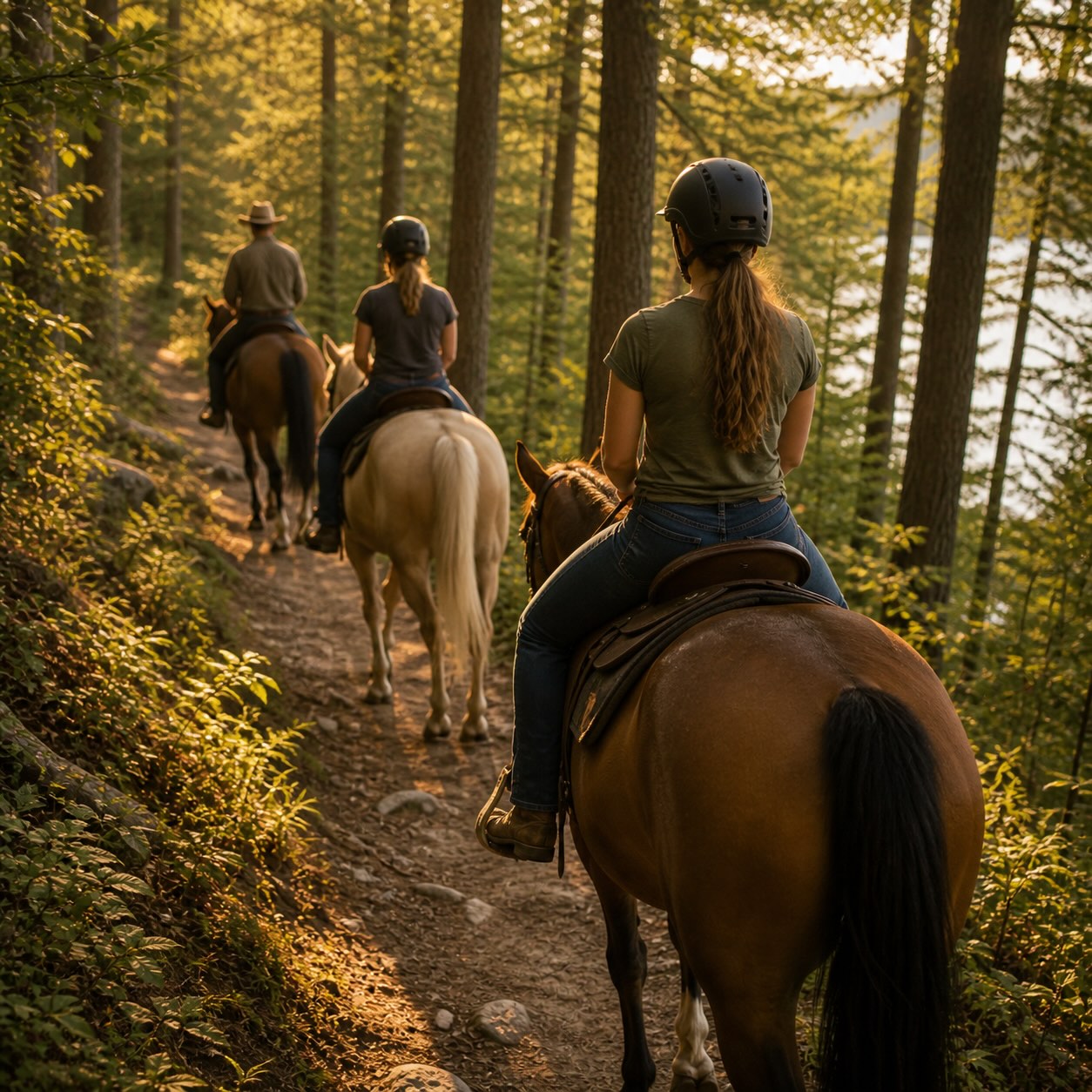
Why horseback in the Adirondacks.
The Adirondack horseback experience is a legacy industry. The southern Adirondacks were home to dozens of working dude ranches in the 1940s and 50s, and several of those ranches still operate today. The Park itself includes designated horse trails in multiple state forest areas — many of them following old logging and stagecoach routes that have been ridden continuously for over a century.
The character of riding here is less Western range and more Eastern wilderness — quiet trails, deep forest, lake crossings, and the particular pleasure of seeing the Park from a saddle rather than from a trailhead. For the visitor, the offering ranges from a one-hour guided ride at any of the active outfitters to a multi-day pack trip that camps at backcountry sites and traverses the Whitney Wilderness or the Cold River horse-trail system.
Several historic dude ranches in the southern Adirondacks — Ridin’-Hy, Roaring Brook, and the smaller family operations around Lake Luzerne and Lake George— still run all-inclusive multi-day stays that combine lodging, meals, and daily rides. It’s an institution that survives largely intact from its mid-century heyday.
The major outfitters.
The active commercial network breaks roughly into three categories: trail-ride outfitters (the standard one- or two-hour guided ride for visitors), all-inclusive dude ranches (lodging plus daily riding), and dedicated pack-trip operators (multi-day backcountry rides). Most outfitters are seasonal, family-run, and book up on summer weekends.
Long-running western Adirondacks outfit. Trail rides from one hour to half-day; pony rides for kids; experienced and beginner trails.
Trail rides through the central Adirondacks. Lessons available. Family-friendly programming with experienced guides.
The Lake Placid-area trail-ride operator. Half- and full-day rides into the Sentinel Range area. Walk-up bookings possible mid-week; reservations recommended summer weekends.
One of the largest surviving dude ranches in the East. All-inclusive packages: lodging, meals, daily rides, evening entertainment. Multi-generation family operation.
Family-oriented dude ranch with on-site lodging, multiple daily rides, and traditional ranch programming.
Multi-day backcountry pack trips through designated horse trail systems. Camping, meals, and gear included; bring a sleeping bag.
Smaller barns and lesson stables operate seasonally across the Park. For the most current list, see the Pursuits directory.
Multi-day pack trips & dude ranching.
The dude ranch tradition in the southern Adirondacks dates to the 1920s, peaked in the 1940s and 50s when the Lake George region had over a dozen working ranches, and has survived in compressed form to today. The remaining ranches operate as all-inclusive resorts — rooms, meals, multiple daily rides, evening entertainment, and (typically) other on-site amenities like swimming pools, archery, and lakefront access. A three-night stay is the typical minimum; weekly stays are common.
For a more wilderness-style experience, several outfitters run multi-day pack trips through the Park’s designated horse-trail systems — particularly the Cold River Horse Trail in the High Peaks Wilderness, the Moose River Plains network in the central Adirondacks near Inlet, and the Pharaoh Lake Wilderness trails near Schroon Lake. Trips typically run 2–5 days, camp at established backcountry sites, and require basic horseback experience. Costs run $400–$700 per day all-inclusive.
What an all-inclusive ranch week actually looks like
- Two rides per day Morning ride before lunch (typically 90 minutes), afternoon ride before dinner. Beginners and experienced riders are split into separate strings.
- Family-style meals Three squares in the dining hall. Cookout night midweek is a fixture at most ranches.
- Evening entertainment Square dance, hayride, bonfire, country music. Quaint by intention.
- Side amenities Pool, archery, paddle sports, hiking trails on property. The ranch is designed so non-riders in a group still have a real day.
- Three-night minimum Weekly stays earn the best rate; long weekends are the entry point.
Trail rides for visitors.
For most visitors, the practical Adirondack horseback experience is a one- to two-hour guided trail ride with one of the regional outfitters. Pricing typically runs $50–$80 for an hour, $100–$150 for a half-day. Most outfitters require advance reservations in summer; mid-week walk-ups are sometimes possible.
The introductory trail ride is genuinely accessible to first-time riders — the horses are calm, the pace is walk and the occasional trot, and the guides are patient. For visitors who have never been on a horse, the right approach is to book the shortest available ride first; you can extend in the saddle if the experience suits you.
Trail-ride bookings by region
- Lake Placid area Sentinel View Stables runs the standard half-day ride into the Sentinel Range. Reservations recommended on summer weekends.
- Saranac region Emerald Springs Ranch runs trail rides and lessons from a working farm setting. Family-friendly.
- Old Forge area Circle B Ranch is the long-running western Adirondacks operator — pony rides for kids and full trail rides for adults.
- Lake George region The dude ranches (Ridin'-Hy, Roaring Brook) take outside riders for trail rides on a space-available basis when not at full guest capacity.
Most outfitters require closed-toed footwear — sneakers or hiking boots are fine; sandals and flip-flops are not. Many outfitters also have weight limits (typically 220–250 pounds depending on the operator); call ahead if this might be a concern.
Bring your own horse.
For visitors traveling with their own horses, the Park offers four primary designated horse-trail systems with parking for trailers, established camping, and marked routes. Trailer-in riding is one of the unsung uses of the Adirondack backcountry — comparable in scale to the Allegheny systems and largely uncrowded outside fall foliage weeks.
NYSDEC publishes regulations for each system — manure handling, group-size limits, designated camping. Read the rules before unloading. The state also operates several horse-accessible state campgrounds, including Lake Eaton and Lewey Lake, with corrals, water access, and direct trail connections.
The four horse-trail systems.
The Moose River Plains Horse Trail
The largest and most-used network in the Park — over 25 miles of marked riding through working forest and along the Moose River. Hamilton County, central Adirondacks, with primary trailer access from Inlet and the Limekiln Lake gate. The terrain is flat to gently rolling — ideal for new riders and longer outings alike.
The Pharaoh Lake Wilderness
Roughly 30 miles of horse-accessible trail in the southeastern Adirondacks, looping past Pharaoh Lake itself and a constellation of smaller ponds. Trailhead access from the Schroon Lake and Ticonderoga sides; the network supports overnight pack trips with designated primitive sites along the way.
The Cold River Horse Trail
The committing one. A backcountry route through the High Peaks Wilderness that follows the Cold River corridor between the Coreys trailhead and the Duck Hole / Cold River area. Long days, real elevation, river fords, and limited bail-out options. Experienced riders and stock only; this is where the major pack-trip operators run their longest itineraries.
The Whitney Wilderness
Horse-accessible trails and primitive camping in the William C. Whitney Wilderness west of Long Lake. Newer to the public-access roster than the other three systems, with a quieter, more remote character. Confirm current trail status with NYSDEC before planning a trip.
Lake Eaton (Long Lake) and Lewey Lake (near Indian Lake) are the two state campgrounds set up for riders bringing their own stock — corrals, trailer parking, and direct trail access. Both fill on holiday weekends; reserve well in advance through ReserveAmerica.
Pick a trail system on the map.
The four horse-trail systems plotted as representative centerlines. Pick one to see its line, region, mileage, and the towns / trailheads / lakes within a few miles.
The committing one. A backcountry route through the High Peaks Wilderness following the Cold River corridor between the Coreys trailhead and the Duck Hole / Cold River area. Long days, real elevation, river fords, and limited bail-out options. Experienced riders and stock only — this is where the major pack-trip operators run their longest itineraries.
Geometry is hand-digitized for visualization only. River fords and weather-dependent. Plan with an experienced outfitter.
Geometry is hand-digitized for visualization, not turn-by-turn navigation. The actual systems include miles of branching trails — bring the relevant DEC map and confirm current access status.
Season, gear & what to expect.
The active Adirondack riding season runs roughly Memorial Day through Columbus Day — about five months. Some outfitters extend into early November weather permitting; some open earlier in May for advanced riders. Mud season (April through early May) is closed across most operations to protect both horse and trail. Winter sleigh rides are offered by a small number of operators but are a different category of experience.
What to wear on a guided ride
- Closed-toed shoes (sneakers or hiking boots are fine)
- Long pants — denim or breeches; no shorts
- A brimmed hat or cap (helmets typically provided)
- Sunscreen — SPF 30+
- Picaridin or DEET bug repellent (June–August)
- A water bottle on a hip belt or in a small pack
- A lightweight rain shell for mountain weather
- Cash or card for the tip — guides are tipped 15–20%
Multi-day pack trips
For a multi-day pack trip, the outfitter will publish a packing list; expect cold-weather layers even in summer (Adirondack nights can drop into the 40s in August at higher elevations). Sleeping bag rated to 30°F, dry bag for clothes, and broken-in riding boots are the non-negotiables.
Bugs are real
Black flies (mid-May through late June) and mosquitoes (June through August) are real on Adirondack horseback rides. Outfitters apply fly spray to the horses; consider picaridin or DEET for yourself. By late August the bug pressure drops sharply.
Safety & shared-trail etiquette.
Helmets
Many outfitters require ASTM/SEI-certified helmets for all riders regardless of age. Bring your own if you have one; otherwise the outfitter provides. New York does not mandate helmets for adults but the major operators do.
Sharing trail with hikers
On multi-use trails — common in the High Peaks and the Pharaoh Lake systems — hikers yield to horses by stepping off the downhill side of the trail and speaking calmly so the horse can place the voice. If you’re the rider, thank them; if you’re the hiker, hold position until the string passes.
Dogs and horses
Off-leash dogs are the most common cause of horseback incidents on shared trails in the Park. Leash up at any trailhead used by riders; the Moose River Plains and Lake Eaton corridors require it during the riding season.
Weather and trail conditions
After heavy rain, designated horse trails can hold water and soft footing for days. Outfitters cancel or reroute when the trail won’t hold a horse safely; trust their judgment and rebook. Lightning above treeline is the same problem on horseback as on foot — turn around early when storms build.
Most of the Park's horse-trail mileage is outside cell coverage. Carry a paper map and a charged headlamp, and let someone know your route and expected return.
Frequently asked questions.
Yes — the introductory trail ride is designed for first-timers. Book the shortest available ride (typically one hour), wear closed-toed shoes, and arrive 20 minutes early for the safety briefing. The horses at the major outfitters are calm and trail-tested.
Most outfitters cap at 220–250 pounds depending on the operator and the available horses. Call ahead if this might be a concern; some larger ranches have heavier-rated stock.
Most outfitters take kids 7+ on the standard trail ride; pony rides are available for younger children at family-oriented operations like Circle B and the dude ranches.
Three-night and weekly all-inclusive packages run roughly $400–$700 per person per night depending on season and ranch. Includes lodging, meals, daily rides, and on-site activities.
Yes — basic riding ability (walk, trot, balance in the saddle for several hours) is the floor. Pack-trip operators publish a riding-readiness questionnaire; be honest about your level so they can match you to the right horse.
Late June through early September is peak — bugs have dropped, foliage hasn't started, weather is consistent. Mid-September through Columbus Day is the second peak for foliage rides; book ahead, those weekends sell out.
Yes — the four designated horse-trail systems (Moose River Plains, Pharaoh Lake, Cold River, Whitney) are open to private stock. NYSDEC publishes manure rules, group-size limits, and designated camping; read them before unloading.
A small number of operators run winter sleigh rides — primarily in the Lake George and Lake Luzerne areas. It's a different category of experience from summer trail riding, but a regional tradition worth a session.
Sources & further reading.
This guide is editorial — written to help you plan well — and is not a substitute for current outfitter availability, NYSDEC trail status, or weather conditions on the day of your ride.