The Best Easy 46ers for Your First Adirondack High Peak.
The Adirondack 46 — the official list of peaks at or above 4,000 feet — is many things, but uniformly approachable isn't one of them. Marcy is twice the day Cascade is. Allen requires a fourteen-mile commitment. Couchsachraga and Cliff sit in the trackless heart of the Park and test bushwhack tolerance more than fitness. Most aspirants start somewhere else: a peak with a clean trail, reasonable mileage, and a summit view that earns the effort.
The five below are the standard introductory 46ers — the ones experienced Adirondackers send first-timers to. Each one is short enough to fit comfortably in a single day and offers a real summit experience (open rock, distance views, the bracing wind that makes the High Peaks the High Peaks). They're listed in rough order of ascending commitment.
If you're climbing to finish the 46, every one of these counts toward the list. If you're climbing to see whether the Adirondacks are for you, any of them will answer that question.
Ranked, and reasoned.
Cascade Mountain.
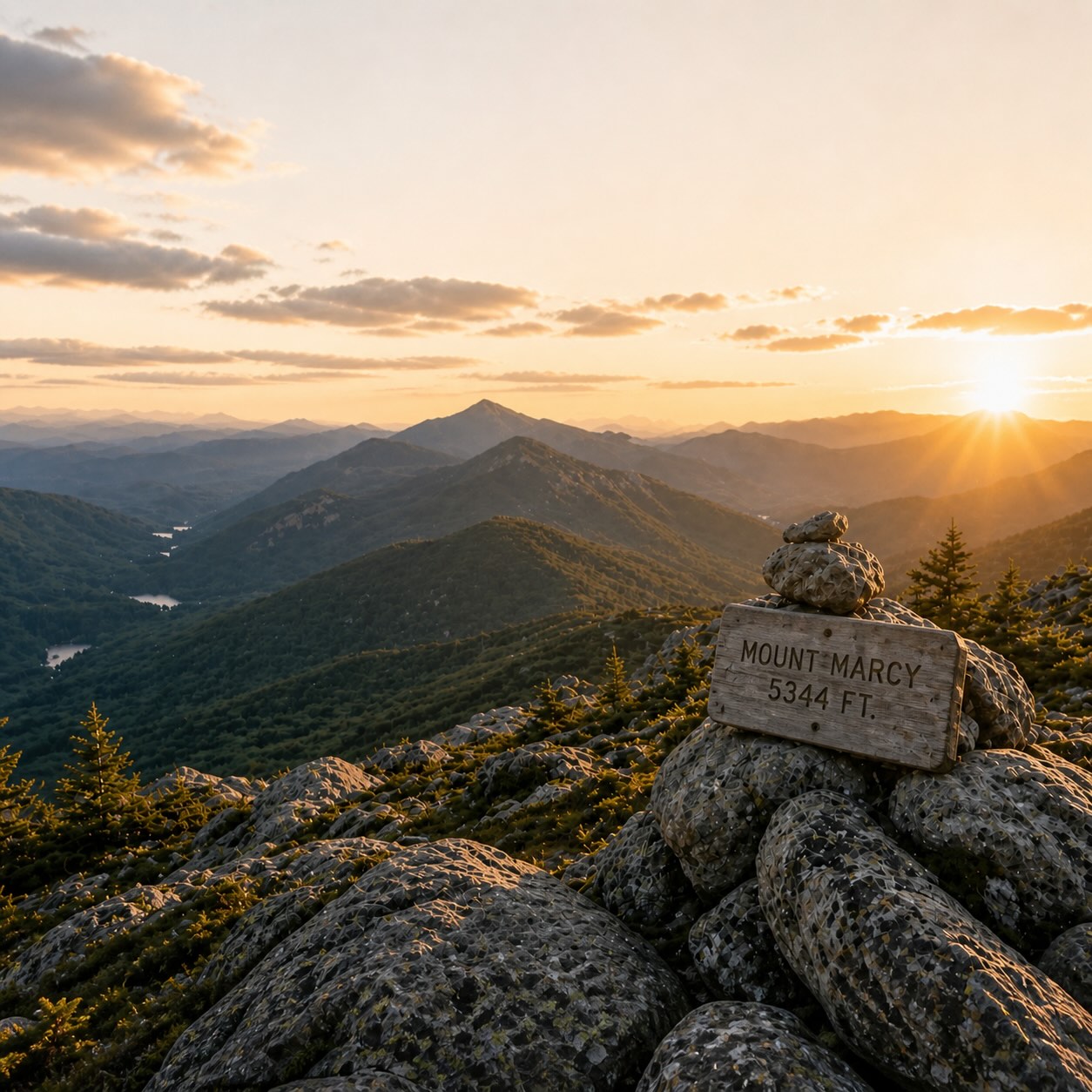
2.4 mi up · 1,940 ft gain · 4,098 ft summitThe default first 46er, and for good reason. The trail leaves Route 73 between Lake Placid and Keene, climbs at a consistent grade through hardwood and spruce, and breaks treeline for the final 0.2 miles onto a treeless rock dome with 360° views from Whiteface to Giant. Under three hours round-trip for most parties; a strong family with older kids can do it.
Open the Page→No. IIPorter Mountain.
+1.4 mi from Cascade col · 4,059 ft summitPair with Cascade in a single push and you've banked two 46ers in one day. Porter is fully wooded — no rock-dome summit — but the trail leaves Cascade's main path at the col and rolls gently across a ridge to a quieter, less-visited peak. The marginal effort over Cascade alone is small; the marginal reward is a 2-for-1.
Open the Page→No. IIIPhelps Mountain.
4.8 mi up · 2,090 ft gain · 4,161 ft summitPhelps doubles the time investment from Cascade while staying technically straightforward. The trail leaves Adirondak Loj on the same path as Marcy, then breaks off to climb steadily to a partially open summit with a sweeping view of the MacIntyre Range. The right phase-2 pick after Cascade — same trailhead, more backcountry feel, no exposure.
Open the Page→No. IVBig Slide Mountain.
8.4 mi loop · 2,820 ft gain · 4,240 ft summitThe full-day pick. From The Garden trailhead in Keene Valley, the loop crosses The Brothers — a three-bump open ridge with shoulder views that keep morale high — before climbing the shoulder of Big Slide proper. The summit isn't bald but offers strong views of the Great Range. Real climb, real day, real reward.
Open the Page→No. VWright Peak.
7.8 mi · 2,400 ft gain · 4,580 ft summitThe 'easy big peak.' Wright shares its approach with Algonquin from Adirondak Loj, then splits off for a short summit scramble over exposed bedrock. The last 0.4 miles is fully above treeline. Pick this when you want the alpine 46er experience without committing to Algonquin or Marcy — same trailhead, considerably less mileage.
Open the Page→Asked at the trailhead.
Cascade Mountain is widely considered the easiest of the 46. The trail is 2.4 miles each way with 1,940 feet of elevation gain, on a well-marked path that finishes on an open summit dome. Most parties round-trip in under four hours.
Yes — Cascade, Porter, and Phelps are commonly done as first-time hikes. That said, all High Peaks trails are rugged, treeless above ~4,000 ft, and exposed to fast-moving weather. Bring proper layers, water, food, a headlamp, and check DEC trail conditions before going.
Most of the easier 46ers (Cascade, Porter, Phelps, Wright, Big Slide, Tabletop, Cascade + Porter combined) fit in a long single day for fit hikers. The harder peaks (Allen, Cliff, Couchsachraga, the Santanonis, the trailless peaks) are typically multi-day or demand pre-dawn starts.
No permits required for day hiking. Trailhead parking can be reserved at the AMR parking lot for Great Range peaks (April–November); the Adirondak Loj trailhead is first-come. A guide isn't required but can be valuable for navigation on trail-less peaks.
Mid-June through early October. July and August are warmest; September brings clearer skies, fewer bugs, and foliage. Avoid muddy season (late April through mid-May) to protect the trails. Winter 46ing is its own sport and requires significantly more gear, skill, and group experience.
Continue with The High Peaks field guide.
The full field guide goes deeper — route planning, seasonal timing, gear, and the long-form editorial behind these picks.