Why Adirondack gardening is its own thing.
The growing season inside the Blue Line is anywhere from ninety to one hundred and forty-five frost-free days, depending on where you stand — and the difference between the coldest spot in the Park and the warmest is a full two USDA hardiness zones.
Gardening here is not gardening in the Hudson Valley, and it is not gardening in northern Vermont, and it is definitely not gardening on a New England seed-catalog cover. The combination of short summers, cold winters, acidic glacial soils, an enthusiastic deer population, and lake-effect snow that arrives in October and leaves in May creates a set of constraints that the standard zone-7 advice column does not address.
The good news: the constraints are predictable. Once you know your hardiness zone, your frost dates, and the specific plants that thrive in acid, cold soil, you can build a garden that produces every year. The bad news: you cannot fight the constraints. Tomatoes in zone 3b are going to need a head start indoors and a season-extender outdoors, every year, period. Hostas anywhere in the Park are going to be eaten by deer, every year, period. We say so honestly because nobody else will.
This guide is structured around those constraints. Find your zone first. Then pick plants that work in your zone. Then add the protective measures — fencing, raised beds, cold frames, row cover — that bridge the gap between what the seed packet says and what the Adirondack June actually delivers.
The USDA refreshed the Plant Hardiness Zone Map in late 2023. Much of the Adirondacks moved a half-zone warmer than the 2012 map — a real climatological shift, not a labeling quirk. If your reference book or seed catalog is from before 2023, your stated zone may be conservative.
Know your zone — the foundation.
The USDA Plant Hardiness Zone map divides North America into ten-degree-Fahrenheit bands based on the average annual extreme minimum winter temperature — the coldest night you can expect in an average year. A plant rated hardy to zone 4 will reliably survive winter where the coldest night gets down to roughly −30 °F, but probably not where it gets down to −40 °F.
The Adirondack Park spans four zones — possibly five if you count a sliver of zone 5b on the Lake Champlain shore — across about a four-degree latitude span. The variation is driven less by latitude than by elevation, proximity to a large lake, and the way cold air pools in valley bottoms.
- Zone 3b (−35 to −30 °F). The coldest pockets: Saranac Lake village, Lake Placid, Tupper Lake — high-elevation interior valleys where cold air settles. Roughly 95-100 frost-free days. Cold-tolerant perennials and short-season vegetables only without protection.
- Zone 4a (−30 to −25 °F). Most of the central Adirondack interior: Long Lake, Indian Lake, Old Forge, Newcomb, Cranberry Lake. Roughly 105-120 frost-free days. The dominant zone of the Park.
- Zone 4b (−25 to −20 °F). Southern foothills and warmer valleys: Warrensburg, Wells, Northville, Schroon Lake. 125-135 frost-free days. Full vegetable garden becomes realistic.
- Zone 5a (−20 to −15 °F). The Lake Champlain corridor and the Lake George shore: Ticonderoga, Crown Point, Westport, Keeseville, Bolton Landing, Lake George village. 140-150 frost-free days. Tomatoes, peppers, basil all thrive; tender perennials overwinter with protection.
- Zone 5b (−15 to −10 °F). A few warmer pockets at the very southern edge of the Park or on the Champlain shore in good aspects. Effectively the same gardening profile as the warmer parts of zone 5a.
The interactive atlas below shows the hamlets with their specific zone, last spring frost, first fall frost, and average growing-season length. Use it to confirm what your community looks like; then use the rest of this guide to pick plants that will actually grow there.
The zone atlas — by hamlet.
Click any hamlet on the map for last frost, first frost, growing-season length, elevation, and what generally thrives there. Toggle individual zones off in the sidebar to focus the view — useful if you’re planning a trip to a specific town and want to compare against your home zone.
- Saranac Lake (village)June 5 – September 10
- Lake PlacidJune 1 – September 12
- Tupper LakeJune 5 – September 10
- Long LakeMay 28 – September 18
- Indian LakeMay 28 – September 18
- Old ForgeMay 25 – September 22
- Cranberry LakeMay 30 – September 15
- NewcombMay 30 – September 15
- Wevertown / North CreekMay 25 – September 25
- SpeculatorMay 28 – September 20
- InletMay 27 – September 20
- Raquette LakeMay 28 – September 18
- Blue Mountain LakeMay 28 – September 18
- WellsMay 22 – September 28
- WarrensburgMay 20 – October 1
- Schroon LakeMay 22 – September 28
- NorthvilleMay 18 – October 3
- Lake George (village)May 15 – October 5
- Bolton LandingMay 17 – October 3
- TiconderogaMay 15 – October 6
- Crown PointMay 14 – October 7
- WestportMay 14 – October 8
- KeesevilleMay 14 – October 7
- Saratoga Springs (just outside)May 10 – October 10
Hamlet centroids are plotted on the 2023 USDA map. Within a single town, microclimate matters: a frost-pocket valley bottom can run a half-zone colder than the listed value, and a south-facing slope above a big lake can run a half-zone warmer. Trust the broader zone, but watch how frost lays in your specific yard.
The first-year Adirondack garden — a step-by-step plan.
If this is your first growing season in the Park, the plan below is a realistic first-year garden — enough to learn, not so much that it overwhelms you in July when the weeds outrun you. The whole project, soup to nuts, takes a weekend to set up and about two to three hours a week through the summer to maintain.
Step 1 — Identify your zone (10 minutes)
Use the atlas above. Make a note of your last spring frost date and your first fall frost date. Every other decision you make this year flows from these two dates.
Step 2 — Pick a sunny spot (1 hour)
Watch your yard for one bright day. The vegetable bed needs at least six hours of direct sun between roughly 10 a.m. and 5 p.m. Less than six hours, and the warm-season crops won’t produce. South-facing is best. East or west exposure works. A north-facing slope under trees does not.
Step 3 — Build a raised bed (one weekend)
In the Adirondacks, a 4×8-foot raised bed beats a ground-level bed nine years out of ten. Raised beds:
- Warm up two to three weeks earlier in spring. The biggest single advantage in a short-season climate.
- Drain better than native ADK soil. Our glacial till holds water and stays cold.
- Are easier to fence against deer. Four corner posts plus deer netting is the whole defense.
- Let you control the soil mix. ADK soils are acidic and low-fertility. A raised bed lets you start with the right substrate.
A simple 4×8 cedar or untreated-pine box, 10-12 inches deep, filled with a 50/50 mix of bagged garden soil and compost, costs roughly $150-$250 in materials and lasts eight to ten years. This is the single best investment a new ADK gardener can make.
Step 4 — Plant a small, forgiving list (the first weekend after last frost)
Resist the catalog. For year one, plant six things:
- Two cherry tomato plants (purchased as starts, not seed)
- One zucchini plant (one is plenty; you will have enough)
- A row of bush beans (direct seed)
- A row of leaf lettuce (direct seed; cut-and-come-again)
- A patch of basil at the tomatoes' feet
- A row of carrots (slow but rewarding; direct seed)
Cherry tomatoes are forgiving where slicing tomatoes are not. Zucchini will produce in any zone of the Park if the deer don’t get it. Bush beans, lettuce, basil, and carrots are the easiest cool-season crops in the Northeast. This list, in a single 4×8 bed, will feed two people through August and teach you what works on your spot.
Step 5 — Water consistently (10 min/day in July)
An inch of water a week, delivered evenly, is the rule. The garden does most of its growing in the first two hours of the morning — water then, not at night (wet leaves overnight invite fungal disease). A simple soaker hose on a $15 timer is the laziest, most effective system.
Step 6 — Fence the deer out (the morning you plant)
Cheap deer netting on stakes, six feet tall, around the perimeter of the bed. This costs $25 and works. Without it, you will lose everything but the tomatoes and basil by August. We’ve made the section below much longer because it is, alongside zone, the defining constraint of gardening here.
Step 7 — Take notes
The biggest thing experienced ADK gardeners have that beginners don’t is a five-year record of what worked. Keep a notebook. Last-frost date this year. First fruit date for each crop. What got eaten. What bolted in the August heat. By year three you will have a location-specific calendar that no seed catalog can give you.
Easy vs. green-thumb — a plant difficulty tier list.
Some plants thrive in Adirondack conditions with almost no help; others demand a strong hand. The list below groups common ornamentals and edibles by difficulty level for an average garden inside the Blue Line.
Tier 1 — Forgiving (any beginner can grow these)
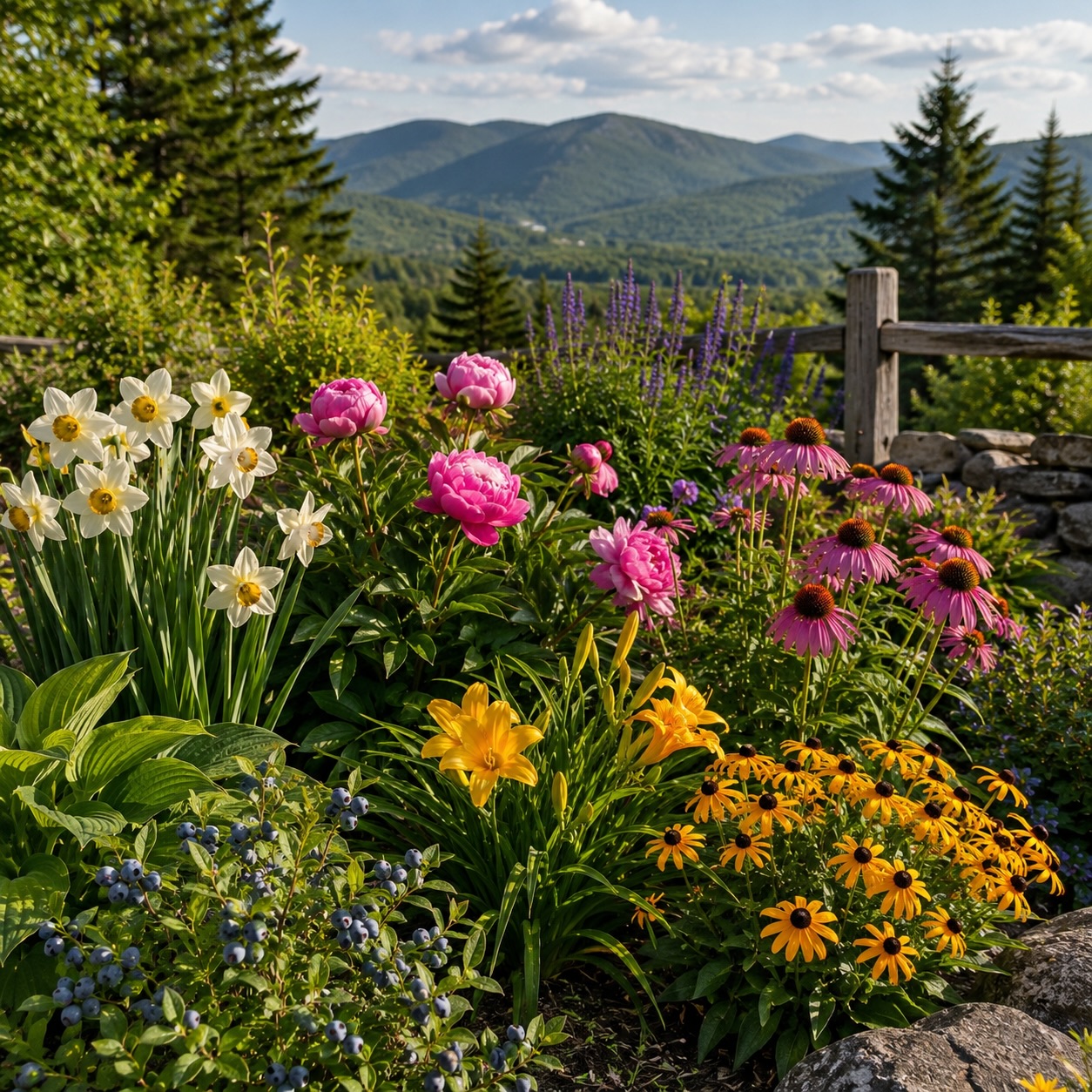
- Daffodils. Plant in fall, ignore forever. Deer-proof, naturalize beautifully, and bloom in the first warm week of April when nothing else has.
- Rhubarb. A single rhubarb crown produces for thirty years. Native plant of cold-climate gardens; loves our acidic soil.
- Hosta. Grows like a weed — BUT deer love them. If you have a fully-fenced yard, hostas are bulletproof. Otherwise, skip them.
- Bush beans. Direct-seed after the last frost. Pick every other day in August. Done by September.
- Zucchini. One plant is enough. Two will overwhelm you.
- Leaf lettuce. Sow every two weeks from April through July. Cool weather favors it.
- Sunflowers. Direct-seed in late May. They’ll be eight feet tall by August.
- Peonies. A peony you plant this year will outlive you. Deer-resistant. Picky about transplanting once established but otherwise zero maintenance.
Tier 2 — Manageable (one season of learning gets you there)
- Cherry tomatoes. Buy starts, don’t start from seed your first year. Stake them. Water consistently.
- Cucumbers. Need vertical support and protection from cucumber beetles. Otherwise prolific.
- Carrots, beets, radishes. Direct-seed; the trick is keeping the seedbed evenly moist for the two weeks they take to germinate.
- Garlic. Plant cloves in mid-October; harvest the following July. Almost no maintenance in between. Try ten cloves the first year.
- Daylilies. Reliable in any sun, mostly deer-resistant (not always; some cultivars get eaten), drought-tolerant once established.
- Coneflowers (Echinacea). Native, pollinator magnet, somewhat deer-resistant. Survives almost anything.
- Black-eyed Susan (Rudbeckia). Native, deer-resistant, blooms August into October.
Tier 3 — Demanding (real work, real reward)
- Slicing tomatoes. Need 75-90 days to mature; in zone 3b/4a this means starts indoors in March, transplant under row cover in late May, and pray for a warm August. Worth it once you nail it.
- Peppers. Heat-loving; struggle in cold ADK summers. A black-plastic mulch and a wall-of-water cloche are nearly required in zone 3b/4a.
- Roses. Most hybrid teas die in zone 4. Hardy rugosa roses thrive. Choose carefully.
- Lavender. Loves heat and sharp drainage — neither of which the ADK offers naturally. A south-facing wall and a raised, gravel-amended bed are required.
- Asparagus. Three-year wait from planting to first real harvest, but then twenty-plus years of production. Patience.
- Blueberries. Love our acid soil but need bird netting, multiple varieties for pollination, and three years to start producing. Long game.
- Apple trees. Zone 4-hardy varieties (Honeycrisp, Liberty, Macoun) work, but need pruning, pest management, and pollination partners.
Tier 4 — Don’t even try (in most of the Park)
- Watermelon, cantaloupe, eggplant. Need 90-100+ days of consistent warm weather we don’t have in zone 3b/4a. Possible in 5a with hoop houses; otherwise heartbreak.
- Most southern-state perennials. Crepe myrtle, gardenia, hibiscus — winter kills them. Don’t buy them at the big-box store.
- Cherry, peach, plum trees. Some hardy cherries work in zone 5a; stone fruit is generally unreliable in the Park.
- Boxwood. Winter desiccation kills it in zone 4. Substitute Korean boxwood or skip it.
Deer-resistant perennials that actually work.
The Adirondack white-tailed deer population is high, persistent, and creative. They will browse virtually any garden in winter when food is scarce, and they will browse most ornamentals in summer if the population pressure is high enough. “Deer-resistant” never means “deer-proof” — it means the plant is far enough down the deer preference list that other food gets eaten first.
These are the perennials that consistently survive deer pressure inside the Park. Bloom times assume a typical zone 4 garden.
Spring (April – early June)
- Daffodils (Narcissus). The single most deer-proof plant in the Northeast. All parts toxic to deer. Plant in fall, in drifts of 25-50 bulbs. Naturalizes for decades.
- Hellebore (Lenten rose). Earliest bloomer of the perennial border; evergreen foliage. Toxic, ignored by deer.
- Allium (ornamental onion). Onion-family scent repels deer. The big purple drumstick blooms are the showy ones; the small species alliums are tougher.
- Bleeding heart (Dicentra). Toxic, ignored. Dies back midsummer but a beautiful May display.
- Lily of the valley. Tough, fragrant, toxic, deer-proof. Spreads — site accordingly.
- Lungwort (Pulmonaria). Fuzzy leaves deer dislike. Spring blooms, summer foliage interest.
Early summer (June – early July)
- Peony. Big, fragrant, beautiful, deer-resistant. Long-lived. Tier-1 in the difficulty list.
- Iris (bearded and Siberian). Both work in ADK. Siberian iris is hardier and longer-lived for our zones.
- Lupine. Toxic, deer-resistant, gorgeous. Self-seeds. Notable in zone 4 — Maine roadsides are famous for them.
- Salvia (perennial). Pungent foliage; ignored by deer. Long bloom period.
- Catmint (Nepeta). Mint family, aromatic, deer-resistant, drought-tolerant, blooms for weeks.
- Foxglove (Digitalis). Toxic, deer-proof, towering spires in June. Biennial in zone 4 — plant two years in a row to establish.
High summer (July – August)
- Bee balm (Monarda). Mint-family, aromatic, deer-resistant. Hummingbird magnet. Native.
- Russian sage (Perovskia). Aromatic, drought-tolerant, deer-proof. Cloud of lavender-blue late July through September.
- Yarrow (Achillea). Fern-like aromatic foliage. Drought-tolerant, deer-resistant, fully hardy.
- Lamb’s ear (Stachys). Fuzzy silver foliage deer hate. A great front-of-border edger.
- Coneflower (Echinacea). Native, somewhat deer-resistant — high deer pressure will eventually eat them, but on average they hold up.
- Black-eyed Susan (Rudbeckia). Native, generally deer-resistant. Reliable late-summer color.
- Monkshood (Aconitum). Toxic, deer-proof, late-blooming blue-purple spires. Wear gloves when handling.
Late summer / fall (August – October)
- Joe Pye weed (Eutrochium). Native, tall (5-7 feet), pink butterfly magnet, deer-resistant.
- Goldenrod (Solidago, cultivated varieties). Native, deer-resistant, late-season pollinator workhorse. The cultivated forms don’t cause hay fever — that’s ragweed’s job.
- Asters (native New England varieties). Late-season purple/blue cloud. Deer-resistant but not deer-proof.
- Sedum ‘Autumn Joy’. Succulent foliage, dusty-pink fall heads. Drought-tolerant, deer-resistant.
Foliage and structure (year-round interest)
- Ferns. Deer leave them alone almost universally. Native ostrich fern, cinnamon fern, and Christmas fern all thrive in ADK woodland conditions.
- Heuchera (coral bells). Generally deer-resistant. Wonderful foliage colors.
- Ornamental grasses. Most grasses (calamagrostis, schizachyrium, panicum) are deer-resistant. Winter structure is a bonus.
- Boxwood substitutes — Korean boxwood, Hicks yew (careful: deer love regular yew). For year-round structure where Korean boxwood survives the cold.
Plants the deer will eat — what to skip (or fence heavily).
An honest list of the plants you will lose to deer in most ADK locations without serious fencing. We list these not to discourage anyone with a fully-fenced garden, but to spare new gardeners the experience of planting their first hosta on Memorial Day and finding it sheared to the ground by the Fourth of July.
- Hosta. Deer candy. Will be eaten within days of leaf-out unless completely fenced.
- Hydrangea (most varieties). Browsed heavily in spring and again as the new growth comes. Smooth hydrangea (Annabelle) and panicle hydrangea survive better than mophead.
- Daylilies (some varieties). Hit-or-miss. High deer pressure eats them all season; lower pressure may leave them alone.
- Tulips. Deer eat the flowers as they emerge. Stick to daffodils for spring bulbs.
- Yew (Taxus). Heavily browsed in winter. A favorite when food is scarce.
- Arborvitae. Eaten to the height of a deer’s reach in winter. The brown lower zone is the unmistakable signature.
- Roses (most non-rugosa varieties). Browsed in spring. Rugosa roses are spiny enough that deer mostly skip them.
- Pansies, impatiens, most annual bedding plants. Salad bar.
- Beans, peas, lettuce, brassicas — every vegetable. Without fencing, none of these survive a hungry deer week.
Nursery tags labeled 'deer-resistant' are written for the average yard in the eastern US — which has far less deer pressure than the typical Adirondack property. Trust local advice over the tag. If your neighbor's hostas get eaten every year, yours will too.
Native trees and shrubs to plant.
The Adirondack Park is the largest publicly-protected forest in the contiguous United States, and the trees that grow here naturally are, almost without exception, the right trees to plant on your property. Native species are adapted to the soil, the snow load, and the winter cold; they support native wildlife; and they don’t require the chemical interventions that non-native ornamentals often demand.
The big four shade trees
- Sugar maple (Acer saccharum). The state tree of New York, and the iconic Adirondack hardwood. Brilliant October color, slow to moderate growth, lives for centuries. Plant young and let it mature.
- Red maple (Acer rubrum). Faster than sugar maple, tolerates wetter soils, even better fall color. The single most adaptable native shade tree.
- Eastern white pine (Pinus strobus). The tallest native conifer in the East. Fast-growing, evergreen, classic ADK silhouette. Needs space — these get to 80+ feet.
- Yellow birch (Betula alleghaniensis). Lives longer than paper birch, golden bark, supports cavity-nesting birds. Underrated.
Smaller native trees
- Paper birch (Betula papyrifera). Iconic white bark, short-lived (50-80 years) compared to oak or maple. Beautiful in clusters of three.
- Tamarack / eastern larch (Larix laricina). A deciduous conifer — needles turn gold and drop in fall. Native to ADK bogs and wet areas. Spectacular in October.
- Serviceberry (Amelanchier). White spring flowers, edible early-summer berries, brilliant fall color, supports native birds. Multi-stemmed small tree or large shrub.
- American mountain ash (Sorbus americana). Bright orange berries persist into winter; cedar waxwings strip them. White spring blooms.
- Striped maple (Acer pensylvanicum) and mountain maple (Acer spicatum). Native understory species. Beautiful in shaded woodland gardens.
Native conifers for screening
- Balsam fir (Abies balsamea). Classic Christmas-tree-shaped Adirondack conifer. Fragrant, dense, beautiful, but short-lived in landscape settings (40-60 years).
- Eastern hemlock (Tsuga canadensis). Excellent screening tree, tolerates shade better than any other native conifer. Watch for hemlock woolly adelgid — a serious pest now established in parts of the Adirondacks.
- White spruce (Picea glauca). Tough, beautiful, classic spire shape. Native to the boreal portion of the Park.
- Red spruce (Picea rubens). The high-elevation native spruce of the High Peaks. Slow but very long-lived.
Native flowering shrubs
- Highbush blueberry (Vaccinium corymbosum). Native, fall color, edible fruit, supports pollinators and birds. Loves our acid soil.
- Witch hazel (Hamamelis virginiana). Native, fall-blooming yellow flowers — one of the latest bloomers of the year.
- Spicebush (Lindera benzoin). Aromatic foliage, native, host plant for the spicebush swallowtail butterfly.
- Winterberry (Ilex verticillata). Deciduous native holly. Red berries persist into winter against the snow.
- Red-osier dogwood (Cornus sericea). Bright red winter stems. Plant near where you’ll see it from the window in February.
How to plant a tree (the short version)
- Plant in fall (September-October) or early spring (April-May) when the ground is workable
- Dig the hole twice as wide as the root ball but only as deep
- Set the root flare (where roots meet trunk) at or slightly above grade — never bury it
- Backfill with the native soil — do not amend with compost in the hole
- Water deeply once a week through the first growing season
- Mulch in a 3-foot ring, but keep mulch off the trunk (no 'mulch volcanoes')
- Stake only if the tree is unstable; remove stakes after one growing season
- Protect young trunks from deer rub with a plastic spiral guard or a wire cage for the first 5 years
The vegetable garden — what works in zone 4.
The defining variable for the ADK vegetable garden is days-to-maturity. With ninety-five frost-free days in the cold corners of the Park and one hundred forty-five in the warm corners, the seed catalog needs to be read with a calculator. A variety that promises “72 days to first harvest” in zone 7 will take 80-90 days in zone 4 — start with that math.
Cool-season vegetables — the workhorses
These thrive in 60-70 °F daytime temperatures and don’t mind a frosty night. They are the foundation of the ADK vegetable garden, planted in April-May and again in August for a fall harvest.
- Peas (snap, snow, shelling). Direct-seed as soon as the soil is workable in April. Done by mid-July.
- Lettuce, spinach, arugula. Sow every two weeks. Bolts (goes to seed) in July heat — pause and resume in August for fall.
- Kale, collards, Swiss chard. Hardiest of the leafy greens; tolerate frost. Sown in May, productive into November.
- Broccoli, cabbage, cauliflower. Buy starts in May, transplant immediately. Need row cover against cabbage moths.
- Carrots, beets, radishes. Direct-seed; thin religiously. Carrots and beets store well in a root cellar.
- Potatoes. Plant seed potatoes in late April-early May; harvest in September. Easy, productive, satisfying.
Warm-season vegetables — pick varieties carefully
These want 70-85 °F daytime temperatures and warm nights. In zones 3b-4a this means starts indoors weeks before last frost, hardening off, transplanting after all frost danger has passed, and ideally a row cover or cloche for the first three weeks outside.
- Tomatoes. Choose short-season varieties (Glacier, Sub-Arctic Plenty, Stupice, Early Girl, Sungold for cherry). Start indoors in mid-March. Transplant after last frost. Stake or cage immediately. Mulch with black plastic in zones 3b-4a.
- Peppers. Harder than tomatoes. Need consistent warmth. Black-plastic mulch and a wall-of-water cloche essentially required for zones 3b-4a. Choose early varieties like King of the North or Cayenne.
- Cucumbers, summer squash, zucchini. Direct-seed after last frost or buy starts. Cucumbers want vertical support. Summer squash and zucchini are foolproof if you keep the cucumber beetle population down.
- Bush beans, pole beans. Direct-seed after last frost. Beans fix their own nitrogen, so no fertilizer needed.
- Winter squash and pumpkins. Need 100-120 days; choose early varieties (Sugar Pie pumpkin, Sweet Dumpling, Buttercup). Direct-seed under black plastic in late May.
Long-game perennial edibles
- Rhubarb. Plant a crown once, harvest for 30 years. Loves our acid soil.
- Asparagus. Three-year wait for first real harvest, then 20+ years of production. Plant in a permanent bed.
- Garlic. Plant cloves in October, harvest the following July. Almost no maintenance.
- Strawberries (June-bearing). Native habitat for them — they thrive in cool ADK summers.
- Raspberries, blackberries. Native varieties (red raspberry, blackcap raspberry, blackberry) thrive in ADK conditions.
- Highbush blueberries. Love our acid soil; produce reliably once established (year 3+).
Season extenders — buying weeks back
- Row cover (Reemay, Agribon). A floating fabric draped over hoops. Buys 4-8 degrees of frost protection — the single highest-leverage tool in a short-season garden.
- Cold frames. Wooden box with a clear top. Starts seedlings four weeks early and protects late-fall crops.
- Low tunnels and high tunnels. Plastic hoop houses; serious commitment but doubles the productive season.
- Black-plastic mulch. Warms soil 8-10 degrees, suppresses weeds. Essential for warm-season crops in zones 3b-4a.
The Adirondack planting calendar.
Approximate calendar for a zone 4a Adirondack garden (Long Lake / Indian Lake / Newcomb baseline). Zones 3b and 4a/4b shift by one to two weeks in either direction. Use your local last frost date from the atlas as the anchor — most of this calendar is keyed to it.
| Month | What to do (zone 4a baseline) |
|---|---|
| March | Start indoors: tomatoes (mid-March), peppers (early March), onions, leeks. Order seeds for the year. |
| April | Outdoors: peas, spinach, lettuce, radishes (direct-seed as soon as soil is workable). Indoors: brassicas (broccoli, cabbage, cauliflower). Late April: plant potatoes. |
| May (1st half) | Outdoors: more peas, lettuce, carrots, beets, Swiss chard, kale. Harden off seedlings on warm days. Watch for last frost — typically late May at lower elevations. |
| May (2nd half) | After last frost: transplant tomatoes, peppers, basil, brassicas. Direct-seed bush beans, summer squash, cucumbers, sunflowers. Use row cover for the first 2-3 weeks. |
| June | Heavy planting month. Keep up with weeding. Harvest first lettuce and radishes. Watch for cabbage moths and Colorado potato beetles. |
| July | Peak weed pressure. First tomatoes start ripening at month's end. Harvest peas, garlic (after scapes form), early bush beans, summer squash. |
| August | Peak harvest. Tomatoes, beans, squash, cucumbers, basil all producing. Sow fall crops: lettuce, spinach, kale, radishes, beets. |
| September | First frost possible mid-September in coldest zones. Harvest winter squash, potatoes, onions. Sow garlic at end of month for next July's harvest. |
| October | First frost across the Park, typically. Hardy greens (kale, spinach) continue. Plant garlic, daffodil bulbs, native trees and shrubs. Mulch perennials. |
| November-March | Garden rests. Order seeds in January-February for the year ahead. Prune fruit trees in March before sap rises. |
Soil and amendments — the Adirondack reality.
Adirondack soils are not garden soils. They are glacial till — sand, silt, clay, and rock left behind by the retreating Laurentide ice sheet about twelve thousand years ago — overlain in most places by a thin layer of acidic forest duff. The result is a soil that is typically:
- Acidic. Soil pH of 4.5 to 5.5 is normal; vegetable gardens want 6.0-6.8. Most ornamental natives like the acidity; most vegetables and turfgrasses do not.
- Low in fertility. Natural nitrogen, phosphorus, and potassium are limited. Long-term gardening requires compost or organic fertilizer inputs.
- Sandy or stony in places, clay-heavy in others. Microscale variation is the rule. Test before you build.
- Cold and slow-draining. Spring snowmelt saturates the ground for weeks; a flat lawn might not dry out until mid-May.
Get a soil test
The single best $25 you can spend on a new garden is a Cornell soil test. Cornell Cooperative Extension in your county will mail you a sample kit; you collect the soil, send it back, and get a report with your pH, macronutrient levels, and lime recommendation. Without this, you are guessing.
Liming for vegetables
Most vegetable gardens in the Adirondacks need lime to raise pH from the native acid value to the 6.0-6.8 range. The soil test tells you how much. Typical applications are 25-50 pounds of pelletized dolomitic lime per 1,000 square feet, every 2-3 years. Apply in fall so it has time to work.
Compost — the single biggest leverage point
An inch of compost added to a vegetable bed every year does more for plant health than any fertilizer. Build a compost pile from kitchen scraps and yard waste; it will be ready in 12-18 months. The Park is loaded with leaf mold from forest floors — a back-corner pile of fall leaves left to sit for two years produces some of the best soil amendment you can buy.
The single most common landscape mistake in the Adirondacks: piling mulch up against the trunk of a young tree like a tiny volcano. This rots the bark, invites disease, and kills more young trees than any pest. Mulch in a flat ring 2-3 inches deep with the trunk completely exposed — bare wood visible above the mulch.
Pests, deer, weather — the variables you don't control.
Deer
Covered at length in sections 6 and 7. The short version: your garden is going to interact with deer; plan for it. A six-foot mesh fence is the gold standard; eight feet is better. Smaller-area protection (raised beds with corner posts and netting) works well for vegetables. Avoid hosta, hydrangea, and yew unless you’re fully fenced.
Black bears
Bears don’t typically raid vegetable gardens, but they will demolish a chicken coop, a beehive, or a bird feeder full of seed in late summer. If you’re keeping chickens or bees, electric fencing is a must.
Smaller mammals
Voles, rabbits, woodchucks, and chipmunks all garden alongside you. Hardware cloth (½-inch wire mesh) buried 6 inches deep at the base of the garden fence stops most of them. Plant a few extra rows for the chipmunks; you won’t change them.
Insect pests
- Cabbage moths. White butterflies in May-June laying eggs on brassicas. Row cover from transplant to harvest prevents the problem completely.
- Cucumber beetles. Striped or spotted beetles that damage squash and cucumber leaves and transmit bacterial wilt. Row cover until flowering; remove for pollination.
- Colorado potato beetles. Black-and-yellow striped beetles on potatoes (and sometimes tomatoes). Hand-pick eggs and larvae; small populations can be managed without spray.
- Aphids. Soft-bodied insects on new growth. A blast from the hose knocks them off; ladybugs and lacewings handle the rest.
- Slugs. Lots of moisture means lots of slugs in the ADK. Beer traps, copper tape, and dry mulch help.
- Black flies. Not a plant pest, but they make Mother’s Day through late June miserable for the gardener. Long sleeves, bug net, picaridin.
Weather — the variables you really don’t control
- Late frost. A frost in early June after warm-season transplants are out is a real possibility in zone 3b. Have row cover ready every night until June 10 in cold zones.
- Early frost. September frost is possible by the second week in zone 3b. Be ready to cover tomatoes and squash one or two nights to buy two more weeks of harvest.
- Hail. Spring and summer thunderstorms occasionally hail. There is nothing to do; replant.
- Drought. Increasingly common in late summer. Soaker hoses on a timer, deep mulch, and patience.
- Wet springs. Some years the snow doesn’t leave until late April and the ground is too wet to work until late May. Raised beds are the answer; the bed is dry while the ground around it is still soup.
Garden centers, nurseries, and seed sources.
A working list of where Adirondack gardeners get plants and supplies — by region. The directory map below pulls live listings as they publish; if your favorite is missing, suggest it.
Regional anchors
- Cornell Cooperative Extension county offices. Essex, Warren, Hamilton, Franklin, and St. Lawrence counties all have CCE offices that run plant sales, master gardener programs, and free soil tests. Single best resource for the new ADK gardener.
- Saratoga / Glens Falls nurseries (south of the Blue Line). Where many ADK gardeners shop for trees, shrubs, and the bigger selection. Worth the drive for major purchases.
- Lake Champlain Valley nurseries. Crown Point, Westport, and Plattsburgh-area nurseries serve the warmer zone 5a corridor — and the working farms.
- Adirondack Coast / Champlain Valley farmers’ markets. Plant starts in May from local growers — often better-adapted than big-box-store plants.
Seed catalogs that work for short-season gardens
- Johnny’s Selected Seeds (Maine). Variety descriptions list days-to-maturity honestly. Strong short-season collection.
- Fedco Seeds (Maine). Cooperative; emphasizes hardy varieties for the Northeast. Reasonably-priced.
- High Mowing Seeds (Vermont). Organic; selected for the Northern climate.
- Pinetree Garden Seeds (Maine). Small seed packets — perfect for new gardeners not trying to stock 1,000 carrot seeds for a 4×8 bed.
- Seed Savers Exchange. Heritage and heirloom varieties — many adapted to short-season climates over a century of growing.
Coordinates are still being indexed for these 5 places. Check back shortly — the map backfills automatically as the enrichment runner finishes.
Live directory data — garden centers, nurseries, and hardware stores are added as they’re published in the listings index. Map updates automatically.
Frequently asked questions.
Zone 3b on the 2023 USDA map — average annual minimum temperature −35 to −30 °F. Tupper Lake and Saranac Lake village are in the same zone. Roughly 95-100 frost-free days. Cold-hardy perennials and short-season vegetables thrive; warm-season crops need indoor starts and season extenders.
Zone 5a on the 2023 USDA map — average annual minimum temperature −20 to −15 °F. The shore of Lake George is the warmest part of the Park, with about 140-145 frost-free days. Full warm-season vegetable garden is realistic.
Varies by location. Zone 3b (Saranac Lake, Lake Placid): early June. Zone 4a (Long Lake, Old Forge): late May. Zone 4b/5a (Warrensburg, Lake George): mid-May. Use the zone atlas above to find your hamlet’s average.
Bush beans. Direct-seed after last frost, water consistently, harvest in August. No transplanting, no major pest pressure, no staking. Lettuce is a close second.
Yes — but choose short-season varieties (Glacier, Sub-Arctic Plenty, Stupice, Early Girl), start indoors in March, transplant in late May after last frost, and use row cover or black plastic mulch in colder zones. Cherry varieties (Sungold) are more forgiving than slicing tomatoes.
Sugar maple, red maple, white pine, yellow birch, paper birch, serviceberry, and balsam fir all thrive across the Park. Plant in fall (September-October) or early spring (April-May), set the root flare at or above grade, mulch in a flat 3-foot ring (never piled against the trunk), water deeply through the first year.
Most reliably deer-proof: daffodils, peonies, lavender, salvia, catmint, Russian sage, yarrow, lamb's ear, monkshood, foxglove, lupine, bleeding heart, lily of the valley, hellebore, ferns, ornamental grasses. Deer-favored: hosta, hydrangea (most), tulips, yew, daylilies, arborvitae, roses, pansies. Plant your fences accordingly.
Acidic (pH 4.5-5.5 typical), low-fertility, mix of glacial till and forest duff. Vegetable gardens need lime to raise pH to 6.0-6.8 and steady compost inputs for fertility. Many native ornamentals (blueberries, rhododendrons, hellebores) thrive in the natural acidity unchanged.
Almost always yes. Raised beds warm up 2-3 weeks earlier in spring, drain better, are easier to fence, and let you control the soil mix from scratch. A 4×8 cedar bed, 12 inches deep, costs $150-250 in materials and lasts 8-10 years. The single best investment for an ADK vegetable garden.
Mid-October. Plant cloves 2-3 inches deep, pointy end up, in a sunny spot with good drainage. Mulch heavily after the ground freezes. Harvest the following July when the lower leaves yellow. The single easiest perennial-ish vegetable in the Adirondacks.
Almost certainly yes — ADK soil is naturally acidic, which blueberries love. Plant two or three different varieties for cross-pollination, in a sunny spot, mulch with pine needles or wood chips. Expect first real harvest in year 3. Use bird netting in fruit season or you'll lose them all.
Anywhere from 95 days in the coldest interior pockets (Saranac Lake, Lake Placid, Tupper Lake) to 145 days on the Lake Champlain shore (Crown Point, Westport, Ticonderoga). The atlas above lists the average for each major hamlet.
The interactive zone atlas above plots the major hamlets. For an exact ZIP-code lookup, the USDA Plant Hardiness Zone Map at planthardiness.ars.usda.gov is the authoritative source. The 2023 revision is what you want — earlier reference books were keyed to the 2012 map, which was a half-zone colder for much of the Adirondacks.
Sources & further reading.
This guide is editorial — written to help you plan well — and is not a substitute for a soil test, an experienced local gardener’s advice, or the specific microclimate of your yard. Trust local experience over the seed packet.