Why this guide exists.
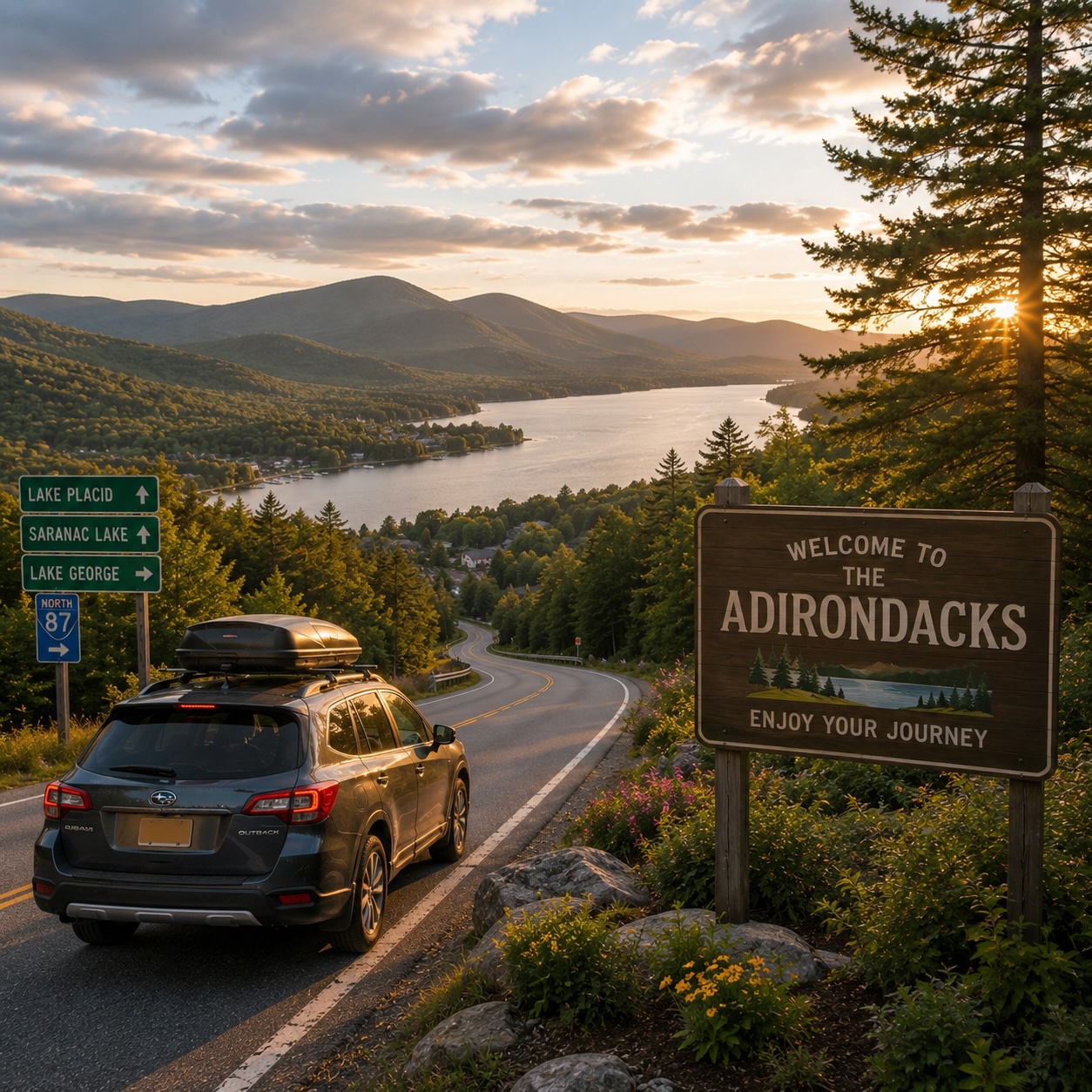
The Adirondack Park is not a uniformly accessible place. Pretending otherwise would be dishonest. But inside that honest framing, the Park contains some of the most thoughtfully-designed accessible outdoor experiences in the eastern United States.
Most travel writing about the Adirondacks defaults to a fully-abled audience: hike up Marcy, paddle the canoe area, swim out to the raft. That writing has its place. But it leaves out an entire category of visitor: people with mobility, sensory, or cognitive accessibility needs, their families, their caregivers — anyone for whom the question “is this trail wheelchair-navigable?” has to be answered before any other planning happens.
The accessible Adirondack experience is real, and it is good. John Dillon Park — a 92-acre wilderness park exclusively for people with disabilities — is unique in the eastern US. The DEC Universal Access trail system is a real, growing network of designed-for-wheelchair-and-adaptive-equipment trails and water access points. The adaptive sports programs at Whiteface and Mt. Van Hoevenberg are operated by ORDA at Olympic-pedigree levels — including the only public-facing adaptive bobsled program in the world. The recently-modernized visitor centers and cultural sites have done substantial accessibility work.
This guide identifies all of it — and is honest about where the Park doesn’t yet measure up.
What we mean by accessible.
“Accessible” is a category, not a binary. A place can be excellent for wheelchair users and poor for people with hearing impairments. A trail can be paved and ramped throughout — and still feature a 12% grade that doesn’t meet ADA standards. We make a few distinctions throughout this guide:
- Mobility accessibility. Wheelchair, walker, scooter, or adaptive-equipment users. The most-documented dimension. We surface surface type (paved, hardened, boardwalk), grade where known, and parking proximity.
- Sensory accessibility. Vision, hearing, and sensory processing. Includes large-print materials, audio description, assistive listening, quiet rooms, sensory-friendly programming. Less consistently documented in the Park.
- Cognitive and developmental accessibility. Includes autism-friendly programming, simplified-language guides, predictable routines, structured environments. Programs like Double H Ranch specifically serve this audience.
- Verified vs. self-reported. We classify operators as 'verified' (we've confirmed details through the operator) or 'reported' (the operator states accessibility but we haven't confirmed specifics). When you need certainty, call ahead.
Some Adirondack experiences — climbing Marcy, paddling the St. Regis canoe area with full backcountry portages, ice-climbing Chapel Pond — cannot be made universally accessible without fundamentally changing them. We don't pretend otherwise. What we DO say: there are real, designed, beautiful accessible experiences in the Park, and they're better than most visitors expect.
The accessibility atlas.
Every verified-accessible place we’ve mapped across the Park, color-coded by category: Universal Access trails, visitor centers, beaches and campgrounds, adaptive sports programs, dedicated accessible parks, and cultural attractions with significant accessibility work. Filter by category in the sidebar. Each marker popup includes accessibility-specific details, operator information, and call-ahead recommendations where relevant.
- John Dillon ParkCentral Adirondacks (Long Lake area)
- Whiteface Mountain Adaptive Snow SportsWilmington
- Mt. Van Hoevenberg Adaptive ProgramsLake Placid
- Double H RanchLake Luzerne
- John Brown Farm State Historic SiteLake Placid
- Heart Lake / Adirondak Loj — accessible loopHigh Peaks
- Mount Van Hoevenberg — accessible trailsLake Placid
- Paul Smiths VICTri-Lakes
- Newcomb VIC (Adirondack Interpretive Center)High Peaks foothills
- Adirondack Welcome Center (I-87 northbound)Southern gateway
- Lake Eaton CampgroundLong Lake
- Fish Creek Pond CampgroundSaranac chain
- Lake Harris CampgroundNewcomb
- The Wild CenterTupper Lake
- Adirondack Experience MuseumBlue Mountain Lake
- Olympic Center — Lake PlacidLake Placid
- Fort TiconderogaChamplain Valley
Find an accessible place — by category, region, or name
Every Google-Places-verified-accessible listing in the Park, plus every wheelchair-accessible parking lot we track. Filter by category, region, or search by name. Each popup shows exactly which accessibility features Google verified (entrance, parking, restroom, seating).
Accessibility is a moving target. Trails get washed out, ramps wear, programs change. This atlas is an editorial starting point — confirm specific accessibility needs (surface, restroom layout, parking distance) with each destination directly before traveling.
John Dillon Park — the flagship.
John Dillon Park, near Long Lake in the central Adirondacks, is a 92-acre privately-operated wilderness park designed and built explicitly and exclusively for people with disabilities and their groups. It is the single most important place in the Adirondack accessibility story — and most visitors to the Park have never heard of it.
The park is the result of a remarkable initiative by International Paper, which dedicated the land and funded the design with one explicit constraint: every part of the visitor experience would be fully accessible. The result is a working wilderness park — woods, ponds, lean-tos, fishing access, canoe launch — built around boardwalks, hardened paths, accessible lean-tos, accessible canoe access, and accessible restrooms throughout.
What’s there
- Accessible boardwalk loops. Wheelchair-navigable trails through pristine Adirondack forest. Designed for self-propelled wheelchair use, adaptive equipment, and family groups.
- Accessible lean-tos. Several wilderness-style lean-tos with accessible approach, sleeping space designed for adaptive equipment, accessible firepit. Sleep 6-8 each.
- Accessible canoe launch. Designed dock with transfer support, accessible canoe and kayak storage. A genuinely wilderness paddling experience.
- Accessible fishing platforms. Designed pond fishing access with adaptive-rod holders and accessible parking immediately adjacent.
- Accessible restrooms. ADA-compliant year-round restrooms — rare for a wilderness park.
How to use it
Use is by reservation only, and the park is reserved for groups in which at least one member has a disability. The park is free — there is no day-use fee or camping fee. Reservations open seasonally; demand is high and the most popular weekends book months in advance.
Reach the park via Route 30, south of the village of Long Lake. The access road is well-maintained gravel; parking is at the trailhead and is accessible.
John Dillon Park is one of the most popular accessible wilderness destinations in the eastern United States. Summer weekends fill months out. Reserve as soon as you know your dates.
DEC Universal Access trails.
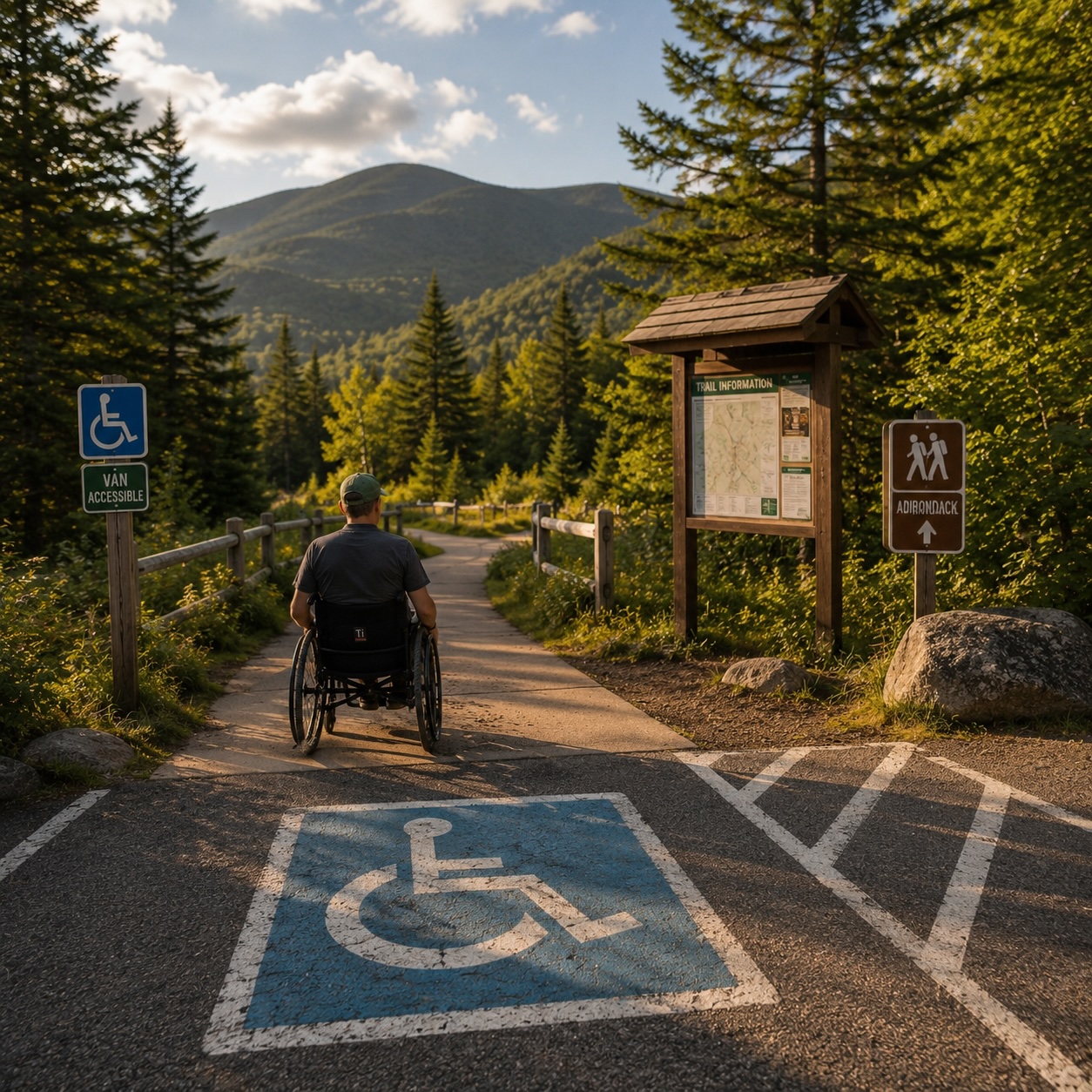
The NY State Department of Environmental Conservation has been building out a network of Universal Access trails across the Forest Preserve for the past three decades. These are designed specifically for wheelchair users, adaptive-equipment users, and anyone for whom standard hiking trails are impractical. Surfaces are paved, hardened gravel, or boardwalk. Grades meet ADA standards where the terrain allows.
The flagship Universal Access trails
- Heron Marsh Trail (Paul Smiths VIC). 0.5-mile boardwalk loop over a wetland and beaver pond. Excellent wildlife viewing. The single most photogenic accessible trail in the Park.
- Sucker Brook Trail loop (Newcomb VIC). Hardened-surface trail through wetland and forest. Connects to indoor exhibits at the AIC visitor center.
- John Brown Farm State Historic Site (Lake Placid). Paved paths through the abolitionist's historic farm. Accessible visitor center and accessible burial site.
- Heart Lake / Adirondak Loj accessible loop. Hardened sections of trail along Heart Lake near the High Peaks gateway. Adirondack Mountain Club operates the property; accessible parking and restrooms at the High Peaks Information Center.
- Mt. Van Hoevenberg trails. Paved sections of the Olympic Sports Complex trail network. Walkable in summer, accessible for adaptive cross-country skiing in winter.
What to expect
Universal Access trails are designed for accessibility but they are still wilderness. Expect:
- Variable conditions after rain. Boardwalks stay accessible; hardened gravel can soften. Check trail conditions with the operator before going.
- Limited shade in some sections. Bring water and sun protection. Trail-side benches are common but not universal.
- Accessible restrooms typically at trailheads, not along trails. Plan accordingly. Most accessible trails are loops of 0.5 to 1.5 miles — short enough that trailhead facilities suffice for most visitors.
- Seasonal closures. Many trails close or become inaccessible in winter due to snow accumulation. Confirm seasonal access — most are May-October.
Accessible visitor centers.
The Park’s visitor centers are the most reliable accessibility infrastructure for first-time visitors. Three are particularly strong:
Paul Smiths VIC
The Paul Smiths Visitor Interpretive Center, operated by Paul Smith’s College, is the northernmost VIC and arguably the most photogenic. Full indoor exhibits accessible; multiple universal-access trails including the boardwalk Heron Marsh loop; accessible parking and restrooms; staff trained on accessibility questions.
Adirondack Interpretive Center (Newcomb VIC)
Operated by SUNY ESF, the Newcomb VIC sits at the southern gateway to the High Peaks. Universal-access Sucker Brook Trail; accessible indoor exhibits with hands-on natural-history programming; accessible restrooms and parking. Particularly strong for families with young children.
Adirondack Welcome Center
The modern Adirondack Welcome Center on I-87 northbound (between Exits 17 and 18) is the first stop for many visitors. Fully ADA-compliant facility with universal-access nature trails, accessible restrooms, visitor information, and refreshments. Excellent stretch break for accessibility-focused travelers heading further north.
Accessible beaches & state campgrounds.
NYSDEC operates approximately 50 state campgrounds across the Adirondacks. A growing subset offers designated accessible sites, accessible restroom and shower facilities, and accessible beach access.
- Lake Eaton Campground (Long Lake). Accessible campsites with ADA-compliant pads, accessible restrooms, and seasonal beach mat to lake edge.
- Fish Creek Pond Campground (Saranac chain). Large campground with multiple accessible sites and accessible swimming access. Wheelchair-accessible picnic tables and fire rings.
- Lake Harris Campground (Newcomb). Smaller campground with accessible sites and accessible lakeshore access.
- Caroga Lake Campground (southern Park). Family-oriented campground with accessible beach access and accessible day-use facilities.
- Lake George Beach State Park (Million Dollar Beach). ADA-compliant access to one of the Park's most-visited public beaches. Accessible parking, accessible bathhouse, accessible swim area.
Reserving an accessible site
State campground reservations go through the NY State campsite system. Accessible sites are marked on the reservation interface. Book early — accessible sites at the most popular campgrounds book months out for summer weekends.
Many state beaches deploy beach access mats from Memorial Day through Labor Day. Off-season, the mats are removed and sand-only access returns. Call ahead before visiting outside peak summer if you need the mat.
Adaptive sports programs.
Whiteface Mountain Adaptive Snow Sports
The adaptive program at Whiteface — operated by ORDA in partnership with Whiteface Disabled Veterans — is one of the most accomplished adaptive ski and snowboard programs in the eastern US. Olympic-pedigree instructors. Full adaptive equipment fleet: sit-skis, bi-skis, mono-skis, outriggers, blind-skiing tethers. Year-round programming includes adaptive mountain biking on Whiteface in summer.
Reserve lessons in advance — equipment fitting and instructor matching takes coordination. The program welcomes first-time adaptive skiers and experienced adaptive athletes alike.
Mt. Van Hoevenberg Adaptive Programs
Mt. Van Hoevenberg — the Olympic Sports Complex — operates adaptive cross-country skiing, adaptive biathlon, and the world’s only public-facing adaptive bobsled program. The bobsled program lets adaptive athletes experience the Olympic track at competition speeds with trained professional pilots.
Also strong: the adaptive luge program, which adapts the technical demands of luge for athletes with physical disabilities. Both bobsled and luge programs run by reservation.
Double H Ranch (Lake Luzerne)
Double H Ranch, founded by Paul Newman and Charles Wood as part of the SeriousFun network, runs year-round adventure programming for children with chronic and life-threatening illnesses. Fully accessible facility. Programs include camping, equestrian, archery, fishing, swimming, and skiing — all designed around accessibility and structured support.
Programs are free for eligible children and families, with enrollment by referral and medical eligibility. For families with eligible children, this is one of the most exceptional accessible experiences in the Northeast.
Museums & cultural sites.
The Wild Center (Tupper Lake)
Tupper Lake’s Wild Center natural history museum is one of the more thoughtfully-accessible cultural attractions in the Park. The Wild Walk treetop boardwalk is wheelchair-accessible via paved ramps that climb gradually to the canopy. All indoor exhibits are fully accessible. Some outdoor trails on the campus are non-accessible; call ahead for specifics.
Adirondack Experience (Blue Mountain Lake)
The Adirondack Experience Museum on Blue Mountain Lake is the Park’s flagship history museum. The hilly hillside campus has historically been accessibility-challenging, but recent renovations have substantially improved access. All major indoor galleries are now accessible; the campus runs accessible trams between key buildings when staffed. Some historic-building exhibits remain limited by the structures themselves.
The Olympic Center (Lake Placid)
The Olympic Center in Lake Placid has been substantially modernized in the last decade. The Olympic Museum is fully accessible. Herb Brooks Arena has accessible viewing throughout. Accessible parking is available at the Olympic Authority Recreation Center (OARC) and along Main Street.
Fort Ticonderoga
The 18th-century star fort has done significant accessibility work in the past decade. Museum galleries and lower-level exhibits are fully accessible. The King’s Garden, Pavilion, and ground-level grounds are accessible via paved paths. The upper fort ramparts, by virtue of being historic structures, include stairs and uneven surfaces and are not fully accessible. A mobility shuttle operates within the grounds during peak season.
For an America 250 itinerary in 2026 — when the fort is running expanded semiquincentennial programming — call ahead about specific event accessibility. The fort staff is responsive and well-prepared.
Accessible lodging.
Lodging accessibility varies dramatically across the Park. The general pattern: modern hotels and major resorts tend to have ADA-compliant rooms and facilities; classic Adirondack lodges, smaller B&Bs, and historic camps often have not been retrofitted. When in doubt, call directly — listing data consistently overstates accessibility.
What to ask before booking
- Roll-in shower vs. tub-only. Many older properties have ADA roll-in showers in only one or two rooms — those rooms book first. Specify.
- Threshold heights. Especially relevant for older buildings. A 2-inch threshold can be a wheelchair barrier.
- Path of travel from parking. Some historic camps require a 100+ foot walk on gravel from the lot to the main building. Confirm.
- Elevator vs. stairs only. Most ADK lodges are two-story; not all have elevators. Ground-floor rooms are sometimes available on request.
- Restaurant and common-area access. Some properties have an accessible room but a non-accessible dining hall or activity space. Ask.
- Service animal policy. All lodgings are legally required to accept ADA-defined service animals (separate from pet policy). Confirm so there's no day-of confusion.
For the highest-confidence accessible stay, the modern hotel chains (Hampton, Best Western, Holiday Inn, Marriott properties) in Lake George, Lake Placid, and Plattsburgh are reliable. For a destination resort, The Sagamore, Mirror Lake Inn, Whiteface Lodge, and the Lake Placid Crowne Plaza have substantial accessibility infrastructure — confirm room-specific details directly.
Sensory & cognitive accommodations.
Sensory and cognitive accessibility is less consistently documented in the Park than physical accessibility. A few notable resources:
- Quiet rooms and sensory-friendly programming. Some VICs (Paul Smiths, Newcomb) and the Wild Center offer designated quiet spaces or sensory-friendly programming windows. Call ahead for current programming.
- Audio descriptive materials. The Olympic Center and the Adirondack Experience museum offer some audio-descriptive options. Inconsistent elsewhere — bring your own assistive device when possible.
- Large-print and Braille. DEC publishes some accessible-format materials. Museums vary. Call ahead.
- ASL interpretation. Larger venues (Olympic Center, fort programming) sometimes offer ASL interpretation on request — give two to three weeks' notice when possible.
- Predictable routines. Programs like Double H Ranch are specifically designed around structured, predictable routines. For independent travel, building a tight itinerary with predictable arrival and departure times helps.
Service animals in the Park.
Under the Americans with Disabilities Act, service animals are permitted in all public accommodations, state parks, restaurants, hotels, and visitor centers throughout the Adirondacks. This includes:
- State campgrounds and DEC trails. Service dogs are permitted; pets follow separate per-property rules.
- Restaurants and lodging. ADA-defined service animals are admitted regardless of pet policy. Two questions are legally permitted by staff: is this a service animal trained to perform tasks for a disability, and what tasks does it perform.
- Visitor centers and museums. Service animals admitted; some sensitive collections may require leash on entry.
Practical note: many of the popular ADK destinations are dog-friendly broadly. The distinction between "service animal" and "well-behaved pet on leash" matters less than in some urban venues. Bring water; trails are long.
Mobility equipment rental.
Mobility equipment rental within the Park is limited. Most visitors who need adaptive equipment travel with their own. A few exceptions:
- Adaptive ski and snowboard equipment. Whiteface Adaptive Snow Sports and Mt. Van Hoevenberg’s adaptive programs include equipment as part of their lesson programs. No rental separate from lessons.
- Beach wheelchairs. Million Dollar Beach (Lake George) maintains a small beach-wheelchair fleet for day use. Reserve through the bathhouse office.
- Standard medical equipment. Local pharmacies in Glens Falls, Plattsburgh, and Saranac Lake stock basic mobility equipment for purchase. For specialty equipment, plan to bring it or arrange with a Capital Region medical-equipment supplier (Albany area) for delivery.
Planning your trip.
For a high-confidence accessible Adirondack trip, the compressed planning timeline:
- Identify your access needs in writing — share with every destination at booking
- Reserve John Dillon Park (if planning a wilderness visit) months ahead — peak summer fills fast
- Confirm specific room accessibility directly with lodging — don't rely on third-party booking listings
- Reserve adaptive sports lessons (Whiteface, Mt. Van Hoevenberg) at least 2 weeks ahead
- Confirm beach mat availability outside peak summer (Memorial Day-Labor Day deployment)
- Check trail conditions with the operator within 48 hours of visit (especially after rain)
- Identify nearest accessible restroom along your route — campground trailheads are reliable
- Confirm service animal admission with each venue when relevant
- Pack a back-up plan — Adirondack weather is unpredictable; have an indoor accessible alternative
- Carry contact info for the local CCE office, ADK Mountain Club, or VIC — for on-the-fly questions
Frequently asked questions.
John Dillon Park, near Long Lake — a 92-acre wilderness park designed exclusively for people with disabilities and their groups. Free with reservation. The only place in the Adirondacks where wilderness camping, accessible canoe launching, and accessible lean-tos all exist by design.
Yes — a real network. The DEC Universal Access trail program includes Heron Marsh Trail at Paul Smiths VIC, Sucker Brook Trail at Newcomb VIC, John Brown Farm State Historic Site near Lake Placid, sections of the Heart Lake area, and accessible portions of the Mt. Van Hoevenberg trail system. All are boardwalk, paved, or hardened gravel; all are short loops (0.5-1.5 miles).
Yes. Whiteface Adaptive Snow Sports — operated through ORDA in partnership with Whiteface Disabled Veterans — provides full adaptive equipment (sit-skis, bi-skis, mono-skis, outriggers, blind-skiing tethers) and Olympic-pedigree instruction. Reserve lessons in advance.
A growing subset. Lake Eaton (Long Lake), Fish Creek Pond (Saranac chain), Lake Harris (Newcomb), Caroga Lake (southern Park), and Lake George Beach State Park all offer accessible sites. Reserve through the NY State campsite system; accessible sites are flagged on the reservation interface.
Substantially so — the Olympic Center and Main Street are accessible; the Olympic Museum, Herb Brooks Arena, John Brown Farm, and Mirror Lake have accessible facilities. Whiteface (15 minutes north) hosts the adaptive sports program. The village itself is walkable and largely flat.
Yes — ADA-defined service animals are permitted in all public accommodations, state parks, restaurants, hotels, and visitor centers, by law. Distinct from pet policy. Practical note: most ADK destinations are also dog-friendly broadly.
Varies by need. Modern hotel chains (Hampton, Best Western, Holiday Inn, Marriott) in Lake George, Lake Placid, and Plattsburgh are most consistently ADA-compliant. For a destination resort, The Sagamore (Lake George), Mirror Lake Inn (Lake Placid), Whiteface Lodge (Lake Placid), and the Crowne Plaza (Lake Placid) have substantial accessibility infrastructure. Always confirm room-specific details directly — listing data overstates accessibility.
At Million Dollar Beach (Lake George), yes — a small beach-wheelchair fleet is available through the bathhouse office. Elsewhere, beach wheelchairs are rare; plan to bring your own or call ahead specifically.
The indoor museum exhibits and the Wild Walk treetop boardwalk are wheelchair-accessible (paved ramps to the canopy). Some outdoor campus trails are not — call ahead for specifics.
Yes — Double H Ranch in Lake Luzerne runs year-round adventure programming for children with chronic and life-threatening illnesses. Free for eligible families. Programs include adaptive camping, equestrian, archery, fishing, swimming, and skiing — all designed around accessibility. Enrollment by referral.
Most modern motor coach service is ADA-compliant. Confirm at booking with the carrier. In-park public transit is otherwise limited; a car (or rideshare) is the practical option.
Limited but growing. The Heron Marsh boardwalk at Paul Smiths VIC is excellent for waterfowl viewing. Lake Eaton has accessible shoreline access. Several DEC properties have accessible viewing platforms — check with the regional DEC office for your destination.
Call the operator directly. Most ADK destinations are responsive to specific accessibility questions when given lead time. For broader trip-planning support, the New York State Office for People With Developmental Disabilities (OPWDD) and the regional Cornell Cooperative Extension offices are both responsive resources.
Sources & further reading.
This guide is editorial — accessibility infrastructure changes over time. Always confirm specific accessibility needs with each destination directly before traveling. If you find information here that’s out of date, we’d like to know.